





Stable Design Patterns (SDPs)(BASE)
Price range: $99.99 through $399.99

Stable Architecture Patterns (SArchPs) Unified Software Architecture on-Demand (USA on-Demand)
Price range: $139.99 through $499.99
Stable Analysis Patterns (SAPs) (BASE)
Price range: $99.99 through $399.99
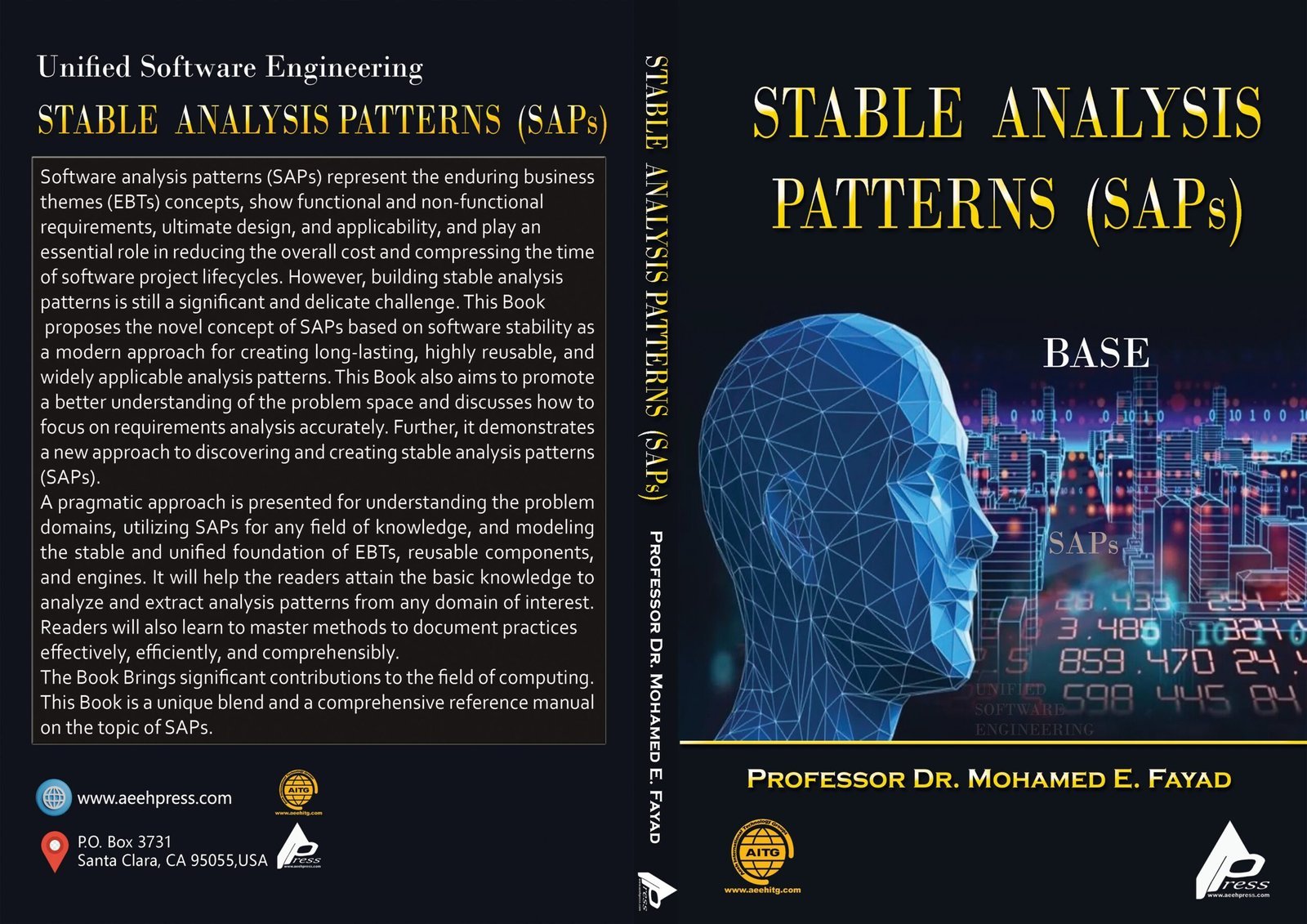
Software analysis patterns (SAPs) represent the enduring business themes (EBTs) concepts, show functional and non-functional requirements, ultimate design, and applicability, and play an essential role in reducing the overall cost and compressing the time of software project lifecycles. However, building stable analysis patterns is still a significant and delicate challenge. This Book proposes the novel concept of SAPs based on software stability as a modern approach for creating long-lasting, highly reusable, and widely applicable analysis patterns. This Book also aims to promote a better understanding of the problem space and discusses how to focus on requirements analysis accurately. Further, it demonstrates a new approach to discovering and creating stable analysis patterns (SAPs). A pragmatic approach is presented for understanding the problem domains, utilizing SAPs for any field of knowledge, and modeling the stable and unified foundation of EBTs, reusable components, and engines. It will help the readers attain the basic knowledge to analyze and extract analysis patterns from any domain of interest. Readers will also learn to master methods to document practices effectively, efficiently, and comprehensibly. The Book Brings significant contributions to the field of computing. This Book is a unique blend and a comprehensive reference manual on the topic of SAPs.
| BOOK | Hardcover, Paperback, Kindle |
|---|
Description
Product details
-
Publisher : AEEH PRESS INC (April 13, 2024)
-
Language : English
-
ISBN :
978-1-964282-74-9
-
Item Weight : 1.14 pounds
-
Dimensions : 6 x 0.68 x 9 inches
-
Illustrations by Mahmoud Asaad
-
Release Date: August 2025 or before
-
Number of Pages – between 450 to 550 pages
-
Book CV Package contains Published & Unpublished
Articles
Columns
Keynotes
Presentations
Short and Long Videos
Theme Issues
$219.99
-
Release Date: August 2025 or before
Number of Pages – (coming soon)
Supplement
Paperback + eSupplement
$6K
-
Release Date: December 2025 or before
Number of Pages – between 1000 to 1200 pages
Cource Notes
Hardbook + Supplement + Cource Material
$9K
Release Date: December 2025 or before
Author:
Dr. M.E. Fayad
Book flyers
Book Press releases
Copyright © 2025 AEEH PRESS INC
All Rights Reserved. No part of this publication may be reproduced, stored in a retrieval system, or transmitted, in any form or by any means, electronic, mechanical, photocopying, recording, or otherwise, without the written permission of the author.
Reviews (0)
Only logged in customers who have purchased this product may leave a review.
Shipping & Delivery


Related products


Avana San Jose & Monticello Apartments in Santa Clara: The Tenant who is the Landlord’s Victim by Dr. Mohamed E. Fayad
Avana San Jose & Monticello Apartments in Santa Clara: The Tenant who is the Landlord's Victim The first six months of living in the apartment were passed peacefully without any disturbances. However, after a while, I faced many problems when I moved to a new apartment. I met issues with the apartment owner due to negligence and delays in maintenance dates, which led to huge losses and damage to my stock of food inside the freezer for more than three months, which increased my financial burden. Moreover, the people there could have been more cooperative. They refused to carry my things or purchases into the apartment because it was on the second floor. Not to mention the racist behavior against me in emails and correspondence, as if there was an organization or paid people behind it. To make matters worse, they sent me a petition from their attorney demanding $420 in fees, which I had nothing to do with. I called my attorney for twenty minutes of legal advice over the phone for $110. He advised me to pay the amount and that there was no need for problems because I would not be able to buy or rent a house if I did not pay. The amount has now reached one thousand dollars, in addition to the losses resulting from neglect of maintenance, estimated at five hundred dollars. It cost me over $1200. The apartment rent is about three thousand dollars per month. You paid it on time. I have the case number filed against them at the police station because the apartment affected my health. Moreover, I asked them to repair it at my own expense. Still, they refused, and no one listened to me, so I decided to leave this place if I received all my dues in total and had an official certificate from them guaranteeing my residence in an apartment unsuitable for human living.


Credit Bureaus and Financial Institutions are nothing but Vindictive Bureaus by Dr. Mohamed E. Fayad
Credit Bureaus and Financial Institutions are nothing but Vindictive Bureaus. I have suffered a lot from the mistreatment of companies, banks, credit bureaus, and Wells Fargo, which I think colluded with the bank I deal with and deliberately destroyed my financial reputation and all my business, which negatively affected all my activities and deprived me of my economic rights by publishing false information about me to all financial institutions and all parties that need a financial report on me. In the last six years, I have compiled a complete record of all credit companies and their offices, due to which I wasted a lot of time contacting all of them on the phone and writing correspondence to them. However, they didn't help me with anything. Moreover, I didn't get any support from them to compensate me for what I suffered, like severe losses and damages, and they unjustly robbed me of money. Please consider these allegations of mine because they are tough. You can check the evidence attached to the book, which includes the latest information about my bank and credit cards and contains many errors and contradictions. I am tired of being rejected and unwarrantedly mistreated by all banks.

Knowledge Map for Unified Domain Analysis (KM-UDA) Volume 01 – Intelligence Technologies
Problem space is the set of all problems and represents "What" are any domain's functional and non-functional requirements? And it is not a subset of the solution space. Knowledge Map for Unified Domain Analysis (KM-UDA) discovers all the truths (the functional and non-functional requirements) about any domain. The existing domain analysis techniques and domain experts are very good at identifying the tangible aspects of any discipline that considers the applications aspect of the analyzed field. KM-UDA forms the basis, core, and strong and unified foundation to understand any domain problem and its solution patterns. KM-UDA can create analysis based on the fundamental concepts of unification and stability. This book contains the following KM-UDA: 1. Knowledge Map of Stable Machine Learning (KM-SML) 2. Knowledge Map of Unified Deep Learning (KM-UDL) 3. Knowledge Map of Unified Black Chain (KM-UBC) 4. Knowledge Map of Stable Wearable Technology (KM-SWT) 5. Knowledge Map of Unified Smart Home (KM-SSH)


Knowledge Map Unified Domain Analysis (KM-UDA) (BASE)
Galileo Galilei said, "All truths are easy to understand once they are discovered; the point is to discover them." Knowledge Map (KM) discovers all the truths about any domain. The existing domain analysis techniques and domain experts are very good at identifying the tangible aspects of any discipline that considers the applications aspect of the analyzed field. Knowledge Map Unified Domain Analysis (KM-UDA) forms the basis, core, and strong and unified foundation to understand any domain problem and its solution patterns. KM-UDA can create reusable and stable pattern languages and their analysis, design, and architectural patterns. KM's main idea is to allow practitioners and developers to master the particular discipline of interest through accurate domain analysis using KMs, via stable patterns and an insightful methodological process. It gives practitioners and developers the necessary means and tools for a complete retrospective of the stable patterns pertinent to a discipline of particular interest and the tidbits of advice on how to use them to satisfy specific needs. This book delineates a new creative process and provides an understanding of the knowledge map for domain analysis based on the fundamental concepts of unification and stability.


Our California government and its institutions neither Listen nor Care by Dr. M.E. Fayad
For several years, I have been trying hard to ward off collective injustice in my arena the injustice of many people and institutions, which is countless. I found no one to help me except God, Lord of the worlds. So I told myself to approach the government and its institutions, the judiciary, and lawyers, seeking help from all of them. Here, I present to them my petitions, letters, and valid evidence so that I may find among them someone who will be fair to me and remove the yoke of injustice from me. It cost me great effort, precious time, and much money, in addition to burning my nerves and deteriorating my health. My lack of resources hardly covered my daily living needs or my medical and health requirements, which prompted me to drown in many debts that exhausted me. In addition, they mistreated me when I demanded my legal rights in all my transactions and entitlements as an elderly American citizen with special needs, but no one listened or cared. It is the first volume among more than thirty-five volumes, containing between its covers all the evidence of letters and petitions showing fraud against my person, which had a disastrous effect on my work, my health, and my entire life, and my responses to all of that with irrefutable evidence


The Brutality of Tyrants – First Volume by Dr. M.E. Fayad,
In The Brutality of Tyrants, Dr. Mohamed Fayad recounts his journey through systemic injustice, racism, and corruption that profoundly impacted both his personal and professional life. His story extends beyond individual experiences, revealing public issues affecting millions of American citizens today. Dr. Fayad’s experiences within academia, healthcare, and financial institutions illustrate how individuals and systems have not only marginalized him but continue to suppress countless others. Facing deliberate negligence, exclusion, and even threats to his life, Dr. Fayad’s narrative highlights the devastating impact of institutional oppression on everyday citizens. This book is not intended to offend any person, institution, group, political party, government, or country. Rather, it is Dr. Fayad’s means of reporting his own experiences, with the hope that recounting these injustices will prevent them from happening to others. His account critiques the failure of justice in America, particularly for marginalized individuals, and underscores the urgent need for reforms across multiple sectors within the nation. The Brutality of Tyrants serves as both a personal memoir and a broader critique of institutional oppression, issuing a strong call for accountability and change in what Dr. Fayad describes as one of the greatest nations on Earth. Through his narrative, he urges readers to confront the corruption and inequality that persist in America, hoping to inspire a collective push toward a fairer, more transparent system for all.

Unified Business Rules Standard (UBRS)
The current business environment's ever-changing market dynamics, like evolving user needs, faults, intrusions, etc., require constant updates to system behavior and resource availability. These changes, however, should be performed without significantly affecting the application structure, thus allowing the system to effortlessly optimize and tune itself at runtime to handle/manage any issues. Business rules are an effective tool to provide flexibility and control for rapidly deploying changes across business operations. However, most organizations still need help to explicitly define or model business rules, primarily because they lack a global and widely acceptable set of standards. Furthermore, current business rule standards are not flexible and adaptable for defining rules that can apply to any other application except the ones they are designed for. Such problem dependencies in traditional standards make them challenging to evolve and, hence, significantly limit their use. The Unified Business Rule Standard (UBRS) eliminates these dependencies by focusing on the core knowledge of the domain. It effectively means the changes can be carried out to the problem-specific components without affecting the core functionality. In other words, updating the business logic can occur without recompiling the application code.


Reviews
There are no reviews yet.