


Knowledge Map for Unified Domain Analysis (KM-UDA) Volume 02 – Software Lifecycle Stages
Price range: $99.99 through $199.99
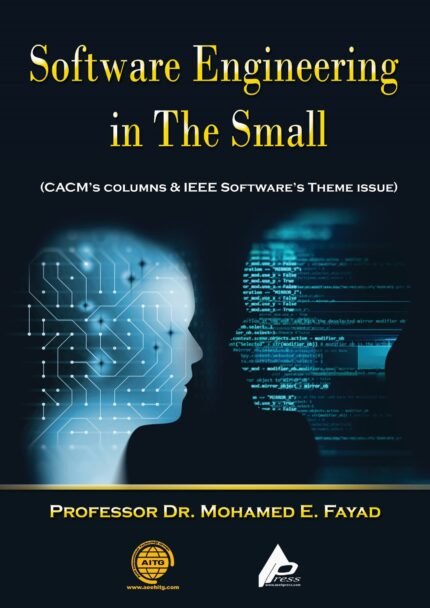
Software Engineering in The Small.
Price range: $69.99 through $149.99
Software Process Development
Price range: $69.99 through $149.99
The software/system process is the fundamental way of abstracting and implementing software/system functional and non-functional requirements, design, architectures, and software testing. Software process describes the steps required to abstract and develop some goal, usually unified skills. Software Processes transform textbook theories and method descriptions into actual action steps. It is essential to realize that processes are codified steps that describe a particular organization’s way of achieving development goals. That means development processes cannot be acquired off the shelf but must be developed over time. Management must support the move to process-based development. The software process must be maintained when schedule pressures loom, or process costs initially slow some development phases. Development Processes are essential for innovation development teams, even in a well-organized group. Individuals will often perceive themselves as less skilled than before, and the routines they have established with others will undoubtedly change. Management must ensure that setting process-oriented development will allow team members to contribute positively. This book: 1. Extends four well-known CACM thinking (O=Object) Objective Software Process Development columns: I. Software Development Processes: The Necessary Evil II. Process Assessment: Considered Wasteful III. Surviving a Process Performance Crash IV. The Art of Managing Multiple Processes 2. Comments and explains responses, 3. Answers many questions. 4. Illustrates Software Development Process in three ways: Textual, Dataflow Diagram, and Activity Diagram.
| BOOK |
Hardcover ,Paperback ,Kindle |
|---|
Description
Product details
-
Publisher : AEEH PRESS INC
-
Language : English
-
ISBN :978-1-964282-56-5
-
Item Weight : 1.14 pounds
-
Dimensions : 6 x 0.68 x 9 inches
-
Illustrations by Mahmoud Asaad
-
Release Date: July 2025 or before
-
Number of Pages – between 250 to 300 pages
-
Author: Professor Dr. Mohamed E. Fayad
Book flyers
Book Press releases
Copyright © 2025 AEEH PRESS INC
All Rights Reserved. No part of this publication may be reproduced, stored in a retrieval system, or transmitted, in any form or by any means, electronic, mechanical, photocopying, recording, or otherwise, without the written permission of the author.
Reviews (0)
Shipping & Delivery


Related products
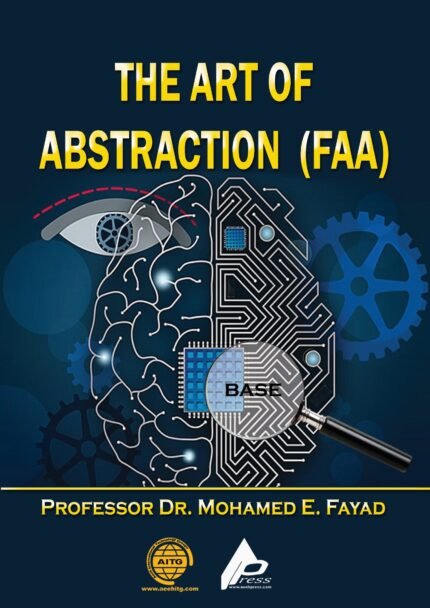
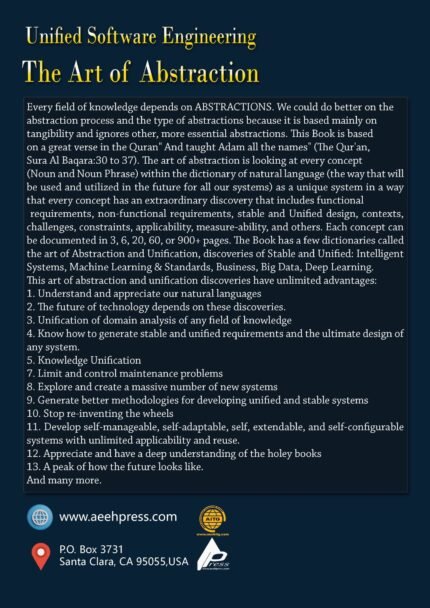
Fayad’s The Art of Abstraction (FAA)
Every field of knowledge depends on ABSTRACTIONS. We could do better on the abstraction process and the type of abstractions because it is based mainly on tangibility and ignores other, more essential abstractions. This Book is based on a great verse in the Quran" And taught Adam all the names" (The Qur'an, Sura Al Baqara:30 to 37). The art of abstraction is looking at every concept (Noun and Noun Phrase) within the dictionary of natural language (the way that will be used and utilized in the future for all our systems) as a unique system in a way that every concept has an extraordinary discovery that includes functional requirements, non-functional requirements, stable and Unified design, contexts, challenges, constraints, applicability, measure-ability, and others. Each concept can be documented in 3, 6, 20, 60, or 900+ pages. The Book has a few dictionaries called the art of Abstraction and Unification, discoveries of Stable and Unified: Intelligent Systems, Machine Learning & Standards, Business, Big Data, Deep Learning. This art of abstraction and unification discoveries have unlimited advantages: 1. Understand and appreciate our natural languages 2. The future of technology depends on these discoveries. 3. Unification of domain analysis of any field of knowledge 4. Know how to generate stable and unified requirements and the ultimate design of any system. 5. Knowledge Unification 7. Limit and control maintenance problems 8. Explore and create a massive number of new systems 9. Generate better methodologies for developing unified and stable systems 10. Stop re-inventing the wheels 11. Develop self-manageable, self-adaptable, self, extendable, and self-configurable systems with unlimited applicability and reuse. 12. Appreciate and have a deep understanding of the holey books 13. A peak of how the future looks like. And many more.

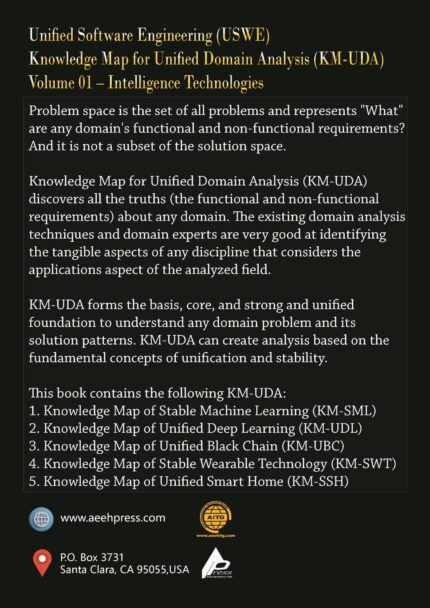
Knowledge Map for Unified Domain Analysis (KM-UDA) Volume 01 – Intelligence Technologies
Problem space is the set of all problems and represents "What" are any domain's functional and non-functional requirements? And it is not a subset of the solution space. Knowledge Map for Unified Domain Analysis (KM-UDA) discovers all the truths (the functional and non-functional requirements) about any domain. The existing domain analysis techniques and domain experts are very good at identifying the tangible aspects of any discipline that considers the applications aspect of the analyzed field. KM-UDA forms the basis, core, and strong and unified foundation to understand any domain problem and its solution patterns. KM-UDA can create analysis based on the fundamental concepts of unification and stability. This book contains the following KM-UDA: 1. Knowledge Map of Stable Machine Learning (KM-SML) 2. Knowledge Map of Unified Deep Learning (KM-UDL) 3. Knowledge Map of Unified Black Chain (KM-UBC) 4. Knowledge Map of Stable Wearable Technology (KM-SWT) 5. Knowledge Map of Unified Smart Home (KM-SSH)
Knowledge Map Unified Domain Analysis (KM-UDA) (BASE)
Galileo Galilei said, "All truths are easy to understand once they are discovered; the point is to discover them." Knowledge Map (KM) discovers all the truths about any domain. The existing domain analysis techniques and domain experts are very good at identifying the tangible aspects of any discipline that considers the applications aspect of the analyzed field. Knowledge Map Unified Domain Analysis (KM-UDA) forms the basis, core, and strong and unified foundation to understand any domain problem and its solution patterns. KM-UDA can create reusable and stable pattern languages and their analysis, design, and architectural patterns. KM's main idea is to allow practitioners and developers to master the particular discipline of interest through accurate domain analysis using KMs, via stable patterns and an insightful methodological process. It gives practitioners and developers the necessary means and tools for a complete retrospective of the stable patterns pertinent to a discipline of particular interest and the tidbits of advice on how to use them to satisfy specific needs. This book delineates a new creative process and provides an understanding of the knowledge map for domain analysis based on the fundamental concepts of unification and stability.
Stable Architecture Patterns (SArchPs) Unified Software Architecture on-Demand (USA on-Demand)
USA on-Demand proposes future trends in "Software Architectures that solve the mentioned challenges above and Look Seriously at "Unified Software Architecture on-Demand (F-USA on-Demand) ." The rapid growth of technology, coupled with the tightened development time and production cost constraints, have imposed tremendous pressure and an intense desire for software enterprises to create new and innovative designs which could respond to rapidly changing business and operating environments. Therefore, enterprises must invest in building stable architectures based on conceptual knowledge more than application context. Any system based on a stable architecture is built in a way that captures the enduring goals that the software is supposed to meet. We refer to these emerging trends of architectures as Architectures on Demand as they are unlimited reusable, adaptable, customizable, extensible, Customizability, self-configurable, self-manageable, and unlimited applicability, according to the future requirements and changes in the operating environments. Adaptability refers to how software system architecture can accommodate changes in its environment constrained by the hardware and software. Customizability refers to the ability of the architecture to be managed and customized by an agent, its users, benefiting applications, and others. Extensibility means that the architecture includes mechanisms for expanding/enhancing the system with new capabilities without making major changes to the architecture and the underlying infrastructure. Good architecture has excellent design principles and guidelines to ensure such architecture's excellency. Self-configurable and self-manageable architectures refer to the architectures of systems that can manage and "self-heal" their properties dynamically at the level of components, connectors, and the underlying infrastructure. The crosscutting concern for all these properties is that dependability should continue to be maintained and evolve the adaptation of the architectures on demand.

Stable Design Patterns (SDPs)(BASE)
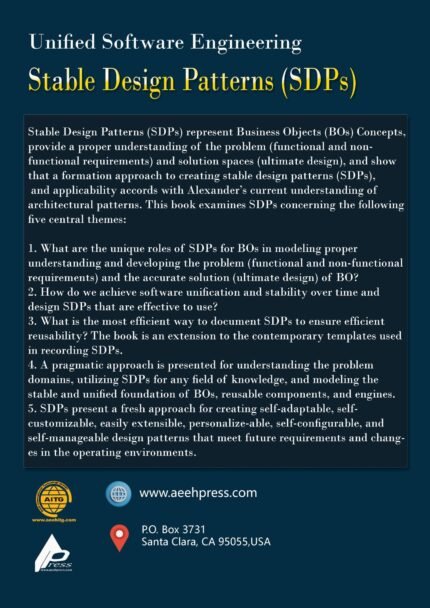
Stable Design Patterns (SDPs) represent Business Objects (BOs) Concepts, provide a proper understanding of the problem (functional and non- functional requirements) and solution spaces (ultimate design), and show that a formation approach to creating stable design patterns (SDPs), and applicability accords with Alexander’s current understanding of architectural patterns. This book examines SDPs concerning the following five central themes: 1. What are the unique roles of SDPs for BOs in modeling proper understanding and developing the problem (functional and non-functional requirements) and the accurate solution (ultimate design) of BO? 2. How do we achieve software unification and stability over time and design SDPs that are effective to use? 3. What is the most efficient way to document SDPs to ensure efficient reusability? The book is an extension to the contemporary templates used in recording SDPs. 4. A pragmatic approach is presented for understanding the problem domains, utilizing SDPs for any field of knowledge, and modeling the stable and unified foundation of BOs, reusable components, and engines. 5. SDPs present a fresh approach for creating self-adaptable, self- customizable, easily extensible, personalize-able, self-configurable, and self-manageable design patterns that meet future requirements and changes in the operating environments.

The Success of Achieving the Ultimate Goals of Any Word When Clearly Defined (Any Skill, Any Performance, Any Reason, and Any Rule)
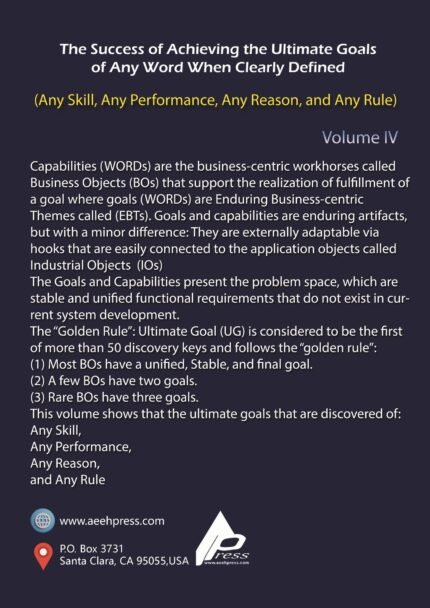
Capabilities (WORDs) are the business-centric workhorses called Business Objects (BOs) that support the realization of fulfillment of a goal where goals (WORDs) are Enduring Business-centric Themes called (EBTs). Goals and capabilities are enduring artifacts, but with a minor difference: They are externally adaptable via hooks that are easily connected to the application objects called Industrial Objects (IOs) The Goals and Capabilities present the problem space, which are stable and unified functional requirements that do not exist in current system development. The “Golden Rule”: Ultimate Goal (UG) is considered to be the first of more than 50 discovery keys and follows the “golden rule”: (1) Most BOs have a unified, Stable, and final goal. (2) A few BOs have two goals. (3) Rare BOs have three goals. This volume shows that the ultimate goals that are discovered of: Any Skill, Any Performance, Any Reason, and Any Rule


The Tale of an Egyptian with an American Passport by Professor Dr. Mohamed E. Fayad
I am an American of Egyptian descent, a university professor, scientist, and founder of some new sciences. I am 72 years old, a resident of San Jose, and a lover of all humanity. However, my company and I have long suffered from collective injustices from most people and organizations I deal with. I am facing disastrous problems and severe obstacles in my work and private life, as if this is an intentional thing and a systematic campaign against me and all the innovators and their companies in Egypt, America, and the Arab countries in general. People, communities, and organizations must unite worldwide to do good and help those in need. However, unfortunately, many people and man y governmental and civil organizations join and gather to do me wrong as if they find pleasure in it, whether in the USA or Egypt, as if they were enjoying my pain, getting high while sipping from my flowing blood in full cups, and eating at the table of my tragedy as if only they were at their last supper. It seems that these problems I suffer from also affect all startups and their founders, as injustice has spread, justice is missing, conscience is dead, and morals are lost. If all these abuses are against me only, then I reluctantly accept them. However, suppose they extend to affect the human community as a whole. In that case, we must stand up and combat this injustice and resist the hateful racism that destroyed the dreams of millions of people, including me. Should we, as a human society, wait for the advent of another Martin Luther King, waging wars to end racism and injustice to all human beings? In Your Hands is a book from a series that depicts my tragedy and personal experience. I deposited my grievances between its covers to be read by every person with a lively conscience, an enlightened mind, and a heart that beats with truth and goodness. This is to relieve me of the injustice that has befallen me and restore some of my lost rights. If you have the same experience and suffer from the same tragedy, please get in touch with me to unite to eliminate the injustice against you and my startup companies. We are the basis of renaissance, civilization, and development worldwide.

الطريق إلى النجاح: تحقيق الأهداف النهائية لأي كلمة عند تحديدها
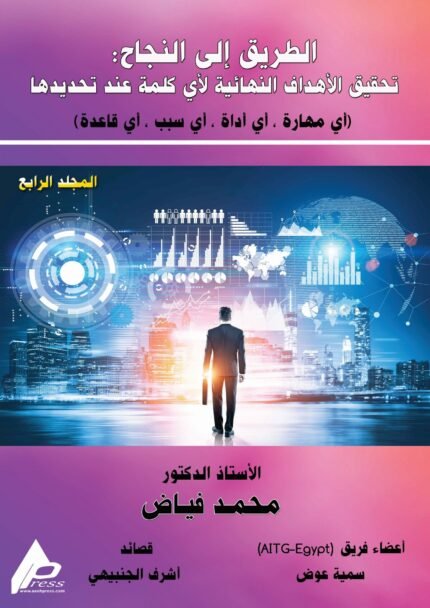
Capabilities (WORDs) are the business-centric workhorses called Business Objects (BOs) that support the realization of fulfillment of a goal where goals (WORDs) are Enduring Business-centric Themes called (EBTs). Goals and capabilities are enduring artifacts, but with a minor difference: They are externally adaptable via hooks that are easily connected to the application objects called Industrial Objects (IOs) The Goals and Capabilities present the problem space, which are stable and unified functional requirements that do not exist in current system development. The “Golden Rule”: Ultimate Goal (UG) is considered to be the first of more than 50 discovery keys and follows the “golden rule”: (1) Most BOs have a unified, Stable, and final goal. (2) A few BOs have two goals. (3) Rare BOs have three goals. This volume shows that the ultimate goals that are discovered of: Any Skill, Any Performance, Any Reason, and Any Rule
Reviews
There are no reviews yet.