






Software Process Development
Price range: $69.99 through $149.99

The Tale of an Egyptian with an American Passport by Professor Dr. Mohamed E. Fayad
Price range: $9.59 through $19.99
Software Engineering in The Small.
Price range: $69.99 through $149.99
Over the past many years, software has become a vital component of almost every business and national economy. Virtually any product or service has become software enabled. As a result, organizations’ competitiveness largely depends on their ability to use the software as a competitive weapon. What makes the competitive landscape more complex is the kind of pressures organizations face in terms of time to market, new features, cost, and, of course, quality and reliability. Furthermore, organizations are finding it increasingly challenging to operate as convergence, discontinuity, and economic boundarylessness lead to the birth of a new breed of global customers. And any organization’s survival—let alone success—is therefore clearly becoming dependent on an ability to understand the characteristics of such international customers and serve them accordingly. In their quest for software excellence, organizations must rely increasingly on software engineering techniques and methodologies and rely on and refine their traditional business strategies. This book: 1. Extends four well-known CACM thinking (O=Object) Objective Software Engineering in the Small columns: I. Software Engineering in the Small II. Problems with Scalability III. Management in the Small IV. Process Improvement in the Small 2. Discuss the September/October 2000, IEEE Software Introduction: Software Engineering in the Small theme Issue 3. Comments and explains responses, 4. Answers many questions.
| BOOK | Hardcover, Paperback, Kindle |
|---|
Description
Product details
-
Publisher : AEEH PRESS INC
-
Language : English
-
ISBN 978-1-964282-56-5
-
Item Weight : 1.14 pounds
-
Dimensions : 6 x 0.68 x 9 inches
-
Illustrations by Mahmoud Asaad
-
Release Date: August 2025 or before
-
Number of Pages – between 350 to 450 pages
-
Author: Professor Dr. Mohamed E. Fayad
Book flyers
Book Press releases
Copyright © 2025 AEEH PRESS INC
All Rights Reserved. No part of this publication may be reproduced, stored in a retrieval system, or transmitted, in any form or by any means, electronic, mechanical, photocopying, recording, or otherwise, without the written permission of the author.
Reviews (0)
Only logged in customers who have purchased this product may leave a review.
Shipping & Delivery


Related products
Knowledge Map Unified Domain Analysis (KM-UDA) (BASE)
Galileo Galilei said, "All truths are easy to understand once they are discovered; the point is to discover them." Knowledge Map (KM) discovers all the truths about any domain. The existing domain analysis techniques and domain experts are very good at identifying the tangible aspects of any discipline that considers the applications aspect of the analyzed field. Knowledge Map Unified Domain Analysis (KM-UDA) forms the basis, core, and strong and unified foundation to understand any domain problem and its solution patterns. KM-UDA can create reusable and stable pattern languages and their analysis, design, and architectural patterns. KM's main idea is to allow practitioners and developers to master the particular discipline of interest through accurate domain analysis using KMs, via stable patterns and an insightful methodological process. It gives practitioners and developers the necessary means and tools for a complete retrospective of the stable patterns pertinent to a discipline of particular interest and the tidbits of advice on how to use them to satisfy specific needs. This book delineates a new creative process and provides an understanding of the knowledge map for domain analysis based on the fundamental concepts of unification and stability.
Stable Analysis Patterns (SAPs) (BASE)
Software analysis patterns (SAPs) represent the enduring business themes (EBTs) concepts, show functional and non-functional requirements, ultimate design, and applicability, and play an essential role in reducing the overall cost and compressing the time of software project lifecycles. However, building stable analysis patterns is still a significant and delicate challenge. This Book proposes the novel concept of SAPs based on software stability as a modern approach for creating long-lasting, highly reusable, and widely applicable analysis patterns. This Book also aims to promote a better understanding of the problem space and discusses how to focus on requirements analysis accurately. Further, it demonstrates a new approach to discovering and creating stable analysis patterns (SAPs). A pragmatic approach is presented for understanding the problem domains, utilizing SAPs for any field of knowledge, and modeling the stable and unified foundation of EBTs, reusable components, and engines. It will help the readers attain the basic knowledge to analyze and extract analysis patterns from any domain of interest. Readers will also learn to master methods to document practices effectively, efficiently, and comprehensibly. The Book Brings significant contributions to the field of computing. This Book is a unique blend and a comprehensive reference manual on the topic of SAPs.
Stable Architecture Patterns (SArchPs) Unified Software Architecture on-Demand (USA on-Demand)
USA on-Demand proposes future trends in "Software Architectures that solve the mentioned challenges above and Look Seriously at "Unified Software Architecture on-Demand (F-USA on-Demand) ." The rapid growth of technology, coupled with the tightened development time and production cost constraints, have imposed tremendous pressure and an intense desire for software enterprises to create new and innovative designs which could respond to rapidly changing business and operating environments. Therefore, enterprises must invest in building stable architectures based on conceptual knowledge more than application context. Any system based on a stable architecture is built in a way that captures the enduring goals that the software is supposed to meet. We refer to these emerging trends of architectures as Architectures on Demand as they are unlimited reusable, adaptable, customizable, extensible, Customizability, self-configurable, self-manageable, and unlimited applicability, according to the future requirements and changes in the operating environments. Adaptability refers to how software system architecture can accommodate changes in its environment constrained by the hardware and software. Customizability refers to the ability of the architecture to be managed and customized by an agent, its users, benefiting applications, and others. Extensibility means that the architecture includes mechanisms for expanding/enhancing the system with new capabilities without making major changes to the architecture and the underlying infrastructure. Good architecture has excellent design principles and guidelines to ensure such architecture's excellency. Self-configurable and self-manageable architectures refer to the architectures of systems that can manage and "self-heal" their properties dynamically at the level of components, connectors, and the underlying infrastructure. The crosscutting concern for all these properties is that dependability should continue to be maintained and evolve the adaptation of the architectures on demand.

Stable Design Patterns (SDPs)(BASE)
Stable Design Patterns (SDPs) represent Business Objects (BOs) Concepts, provide a proper understanding of the problem (functional and non- functional requirements) and solution spaces (ultimate design), and show that a formation approach to creating stable design patterns (SDPs), and applicability accords with Alexander’s current understanding of architectural patterns. This book examines SDPs concerning the following five central themes: 1. What are the unique roles of SDPs for BOs in modeling proper understanding and developing the problem (functional and non-functional requirements) and the accurate solution (ultimate design) of BO? 2. How do we achieve software unification and stability over time and design SDPs that are effective to use? 3. What is the most efficient way to document SDPs to ensure efficient reusability? The book is an extension to the contemporary templates used in recording SDPs. 4. A pragmatic approach is presented for understanding the problem domains, utilizing SDPs for any field of knowledge, and modeling the stable and unified foundation of BOs, reusable components, and engines. 5. SDPs present a fresh approach for creating self-adaptable, self- customizable, easily extensible, personalize-able, self-configurable, and self-manageable design patterns that meet future requirements and changes in the operating environments.


The Brutality of Tyrants – First Volume by Dr. M.E. Fayad,
In The Brutality of Tyrants, Dr. Mohamed Fayad recounts his journey through systemic injustice, racism, and corruption that profoundly impacted both his personal and professional life. His story extends beyond individual experiences, revealing public issues affecting millions of American citizens today. Dr. Fayad’s experiences within academia, healthcare, and financial institutions illustrate how individuals and systems have not only marginalized him but continue to suppress countless others. Facing deliberate negligence, exclusion, and even threats to his life, Dr. Fayad’s narrative highlights the devastating impact of institutional oppression on everyday citizens. This book is not intended to offend any person, institution, group, political party, government, or country. Rather, it is Dr. Fayad’s means of reporting his own experiences, with the hope that recounting these injustices will prevent them from happening to others. His account critiques the failure of justice in America, particularly for marginalized individuals, and underscores the urgent need for reforms across multiple sectors within the nation. The Brutality of Tyrants serves as both a personal memoir and a broader critique of institutional oppression, issuing a strong call for accountability and change in what Dr. Fayad describes as one of the greatest nations on Earth. Through his narrative, he urges readers to confront the corruption and inequality that persist in America, hoping to inspire a collective push toward a fairer, more transparent system for all.
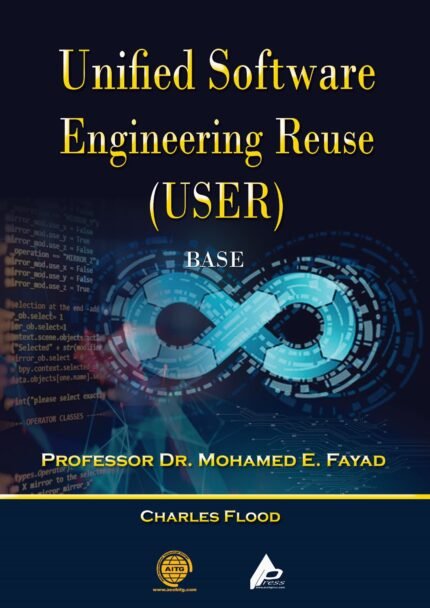
Unified Software Engineering Reuse (USER)
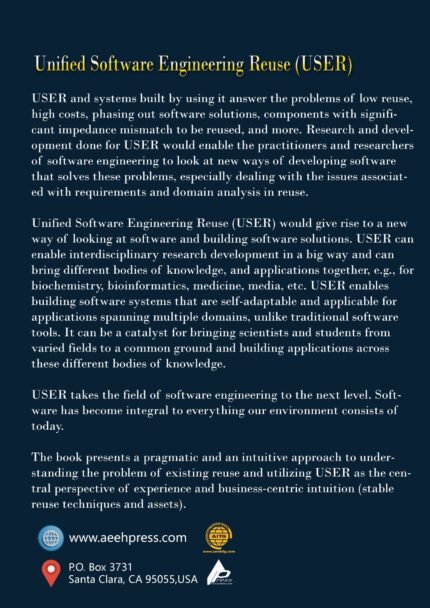
USER and systems built by using it answer the problems of low reuse, high costs, phasing out software solutions, components with significant impedance mismatch to be reused, and more. Research and development done for USER would enable the practitioners and researchers of software engineering to look at new ways of developing software that solves these problems, especially dealing with the issues associated with requirements and domain analysis in reuse. Unified Software Engineering Reuse (USER) would give rise to a new way of looking at software and building software solutions. USER can enable interdisciplinary research development in a big way and can bring different bodies of knowledge, and applications together, e.g., for biochemistry, bioinformatics, medicine, media, etc. USER enables building software systems that are self-adaptable and applicable for applications spanning multiple domains, unlike traditional software tools. It can be a catalyst for bringing scientists and students from varied fields to a common ground and building applications across these different bodies of knowledge. USER takes the field of software engineering to the next level. Software has become integral to everything our environment consists of today. The book presents a pragmatic and an intuitive approach to understanding the problem of existing reuse and utilizing USER as the central perspective of experience and business-centric intuition (stable reuse techniques and assets).


Wells Fargo: a symbol of denial and irresponsibility by Dr. Mohamed E. Fayad
Credit Bureaus and Financial InsWells Fargo: a symbol of denial and irresponsibility I became at the end of my rope after my rights were lost, my reputation was tarnished, and my financial and social situation was weak when my ex-wife seized the opportunity to open two accounts at Wells Fargo Bank without my knowledge in 2012. Moreover, in collaboration with a bank employee, she forged my signature during my illness and heart transplant in July 2016. My ex-wife kept withdrawing large sums of money from those accounts. After discovering the two accounts in 2018, they were closed. As a result, this matter left a bad reputation in my financial situation and significantly harmed me. Due to this, I fell into significant problems, including being deprived of financial transactions with the bank and being refused any requests I submitted. Moreover, funding sources stopped, and many of my projects stopped with them. My request to open an account for my publishing house was denied despite having all the necessary legal papers. Then, I submitted complaints to the bank to investigate the matter, primarily related to the crime of forging my signature. Still, the case has not been decided so far, and my complaint has not been answered nor investigated as if I were screaming in a desert where no one responded to my call or felt my suffering. The ugliest thing is the inhumane treatment that the bank employees at Wells Fargo used to deal with me. The bank took arbitrary measures against me and my commercial accounts and regularly disbursed vast sums of money to several institutions without my consent. The bank deliberately spent vast sums of money on my ex-wife, who withdrew my savings and money without my permission and knowledge, not to mention the mistreatment by the bank employees. titutions are nothing but Vindictive Bureaus. I have suffered a lot from the mistreatment of companies, banks, credit bureaus, and Wells Fargo, which I think colluded with the bank I deal with and deliberately destroyed my financial reputation and all my business, which negatively affected all my activities and deprived me of my economic rights by publishing false information about me to all financial institutions and all parties that need a financial report on me. In the last six years, I have compiled a complete record of all credit companies and their offices, due to which I wasted a lot of time contacting all of them on the phone and writing correspondence to them. However, they didn't help me with anything. Moreover, I didn't get any support from them to compensate me for what I suffered, like severe losses and damages, and they unjustly robbed me of money. Please consider these allegations of mine because they are tough. You can check the evidence attached to the book, which includes the latest information about my bank and credit cards and contains many errors and contradictions. I am tired of being rejected and unwarrantedly mistreated by all banks.

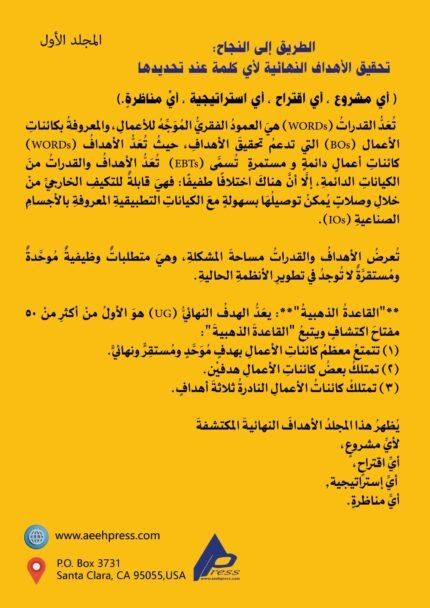
الطريق إلى النجاح: تحقيق الأهداف النهائية لأي كلمة عند تحديدها
Capabilities (WORDs) are the business-centric workhorses called Business Objects (BOs) that support the realization of fulfillment of a goal where goals (WORDs) are Enduring Business-centric Themes called (EBTs). Goals and capabilities are enduring artifacts, but with a minor difference: They are externally adaptable via hooks that are easily connected to the application objects called Industrial Objects (IOs) The Goals and Capabilities present the problem space, which are stable and unified functional requirements that do not exist in current system development. The “Golden Rule”: Ultimate Goal (UG) is considered to be the first of more than 50 discovery keys and follows the “golden rule”: (1) Most BOs have a unified, Stable, and final goal. (2) A few BOs have two goals. (3) Rare BOs have three goals. This volume shows that the ultimate goals that are discovered of: Any Project, Any Proposal, Any Strategy, and Any Debate.
Reviews
There are no reviews yet.