




Stable Architecture Patterns (SArchPs) Unified Software Architecture on-Demand (USA on-Demand)
Price range: $139.99 through $499.99

Unified Software Engineering Reuse (USER)
Price range: $129.99 through $499.99
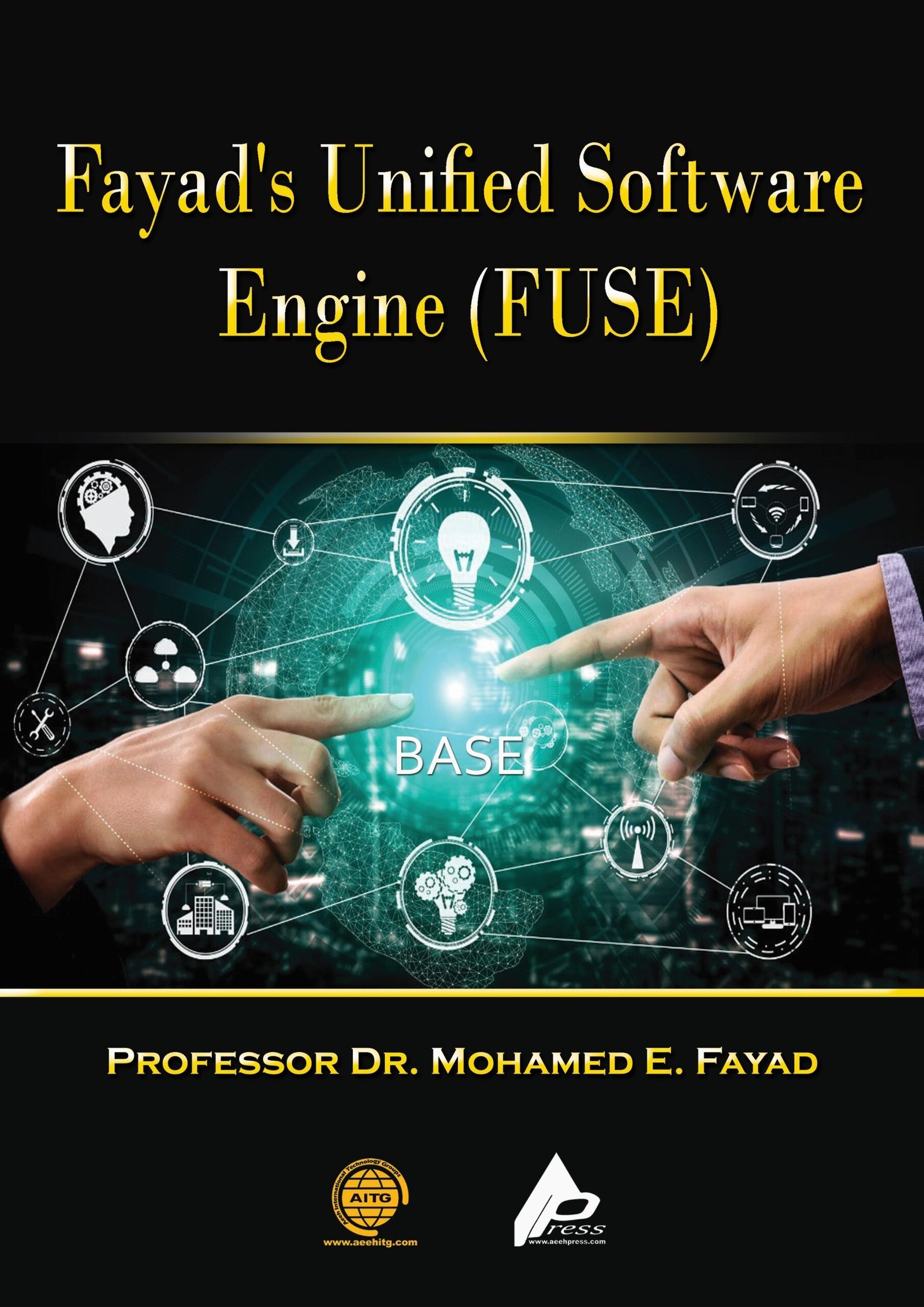
Fayad’s Unified Software Engine (FUSE)
Price range: $179.99 through $599.99
A fuse is a standard device found in any electrical system. Examples include a home, an automobile, a power tool, and many more. The fuse itself is standard and comes in a relatively small number of variants about the required application and the amperage or load the fuse is expected to carry. For a particular application and load, fuses are typically interchangeable. If the FUSE fails, the circuit is open and will not conduct electricity. Plug in a new fuse, and the circuit is complete and resumes operation. These software programs have insidious problems, such as Lack of reliability; Lack of stability/unstable; Excessively costly (billions) to build, purchase and operate; Brittle; Software projects that continue to fail at an alarming rate; hardware dependency; maintenance nightmare; etc. The Ultimate Alternative is Fayad’s Unified Software Engine (FUSE). 1) Capture the art, science, and engineering of the engine; 2) Capture and develop the engine’s unified and stable functional and non-functional requirements; 3) Develop the ultimate design and unified software architecture on-demand of the engine; 4) The new and improved next generation of solutions; 5) Built on any common core infrastructure, e.g., SaaS infrastructures; 6) Facilitate on-demand, highly reusable architectures and applications with rapid times and open space to the market, starting from require ments to final product delivery; 7) Incorporating qualities such as scalability, adaptability, maintainability, unlimited reuse and applicability, and many more; 8) Stop building instance-oriented systems and reinventing the wheels; 9) Prevent hardware dependencies, etc.
| BOOK | Hardcover, Paperback, Kindle |
|---|
Description
Product details
-
Publisher : AEEH PRESS INC (April 13, 2024)
-
Language : English
-
ISBN : 978-1-964282-71- 8
-
Item Weight : 1.14 pounds
-
Dimensions : 6 x 0.68 x 9 inches
-
Illustrations by Mahmoud Asaad
-
Release Date: December 2025 or before
-
Number of Pages – between 650 to 750 pages
-
Book CV Package contains Published & UnpublishedArticlesColumnsKeynotesPresentationsShort and Long VideosTheme Issues $219.99
-
Release Date: August 2025 or before
-
Number of Pages – (coming soon)
Supplement
Paperback + eSupplement
$12K
-
Release Date: December 2025 or before
-
Number of Pages – between 1400 to 2000 pages
Cource Notes
Hardbook + Supplement + Cource Material
$15K
-
Release Date: December 2025 or before
Author:
Professor Dr. Mohamed E. Fayad
Book flyers
Book Press releases
Copyright © 2025 AEEH PRESS INC
All Rights Reserved. No part of this publication may be reproduced, stored in a retrieval system, or transmitted, in any form or by any means, electronic, mechanical, photocopying, recording, or otherwise, without the written permission of the author.
Reviews (0)
Only logged in customers who have purchased this product may leave a review.
Shipping & Delivery


Related products
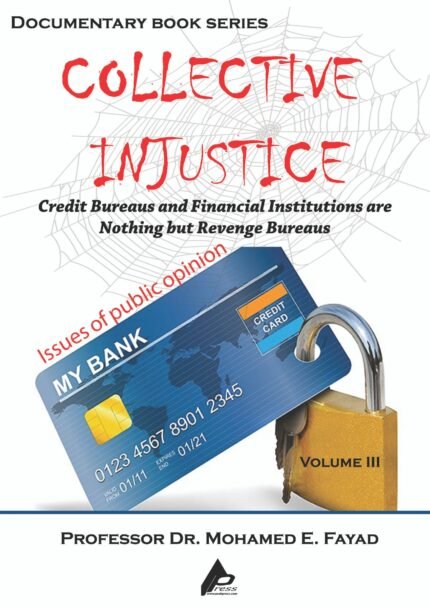

Credit Bureaus and Financial Institutions are nothing but Vindictive Bureaus by Dr. Mohamed E. Fayad
Credit Bureaus and Financial Institutions are nothing but Vindictive Bureaus. I have suffered a lot from the mistreatment of companies, banks, credit bureaus, and Wells Fargo, which I think colluded with the bank I deal with and deliberately destroyed my financial reputation and all my business, which negatively affected all my activities and deprived me of my economic rights by publishing false information about me to all financial institutions and all parties that need a financial report on me. In the last six years, I have compiled a complete record of all credit companies and their offices, due to which I wasted a lot of time contacting all of them on the phone and writing correspondence to them. However, they didn't help me with anything. Moreover, I didn't get any support from them to compensate me for what I suffered, like severe losses and damages, and they unjustly robbed me of money. Please consider these allegations of mine because they are tough. You can check the evidence attached to the book, which includes the latest information about my bank and credit cards and contains many errors and contradictions. I am tired of being rejected and unwarrantedly mistreated by all banks.

Knowledge Map for Unified Domain Analysis (KM-UDA) Volume 02 – Software Lifecycle Stages
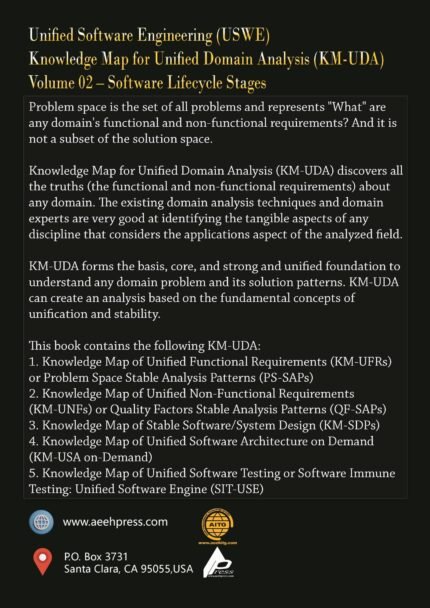
Problem space is the set of all problems and represents "What" are any domain's functional and non-functional requirements? And it is not a subset of the solution space. Knowledge Map for Unified Domain Analysis (KM-UDA) discovers all the truths (the functional and non-functional requirements) about any domain. The existing domain analysis techniques and domain experts are very good at identifying the tangible aspects of any discipline that considers the applications aspect of the analyzed field. KM-UDA forms the basis, core, and strong and unified foundation to understand any domain problem and its solution patterns. KM-UDA can create an analysis based on the fundamental concepts of unification and stability. This book contains the following KM-UDA: 1. Knowledge Map of Unified Functional Requirements (KM-UFRs) or Problem Space Stable Analysis Patterns (PS-SAPs) 2. Knowledge Map of Unified Non-Functional Requirements (KM-UNFs) or Quality Factors Stable Analysis Patterns (QF-SAPs) 3. Knowledge Map of Stable Software/System Design (KM-SDPs) 4. Knowledge Map of Unified Software Architecture on Demand (KM-USA on-Demand) 5. Knowledge Map of Unified Software Testing or Software Immune Testing: Unified Software Engine (SIT-USE)

Our California government and its institutions neither Listen nor Care by Dr. M.E. Fayad
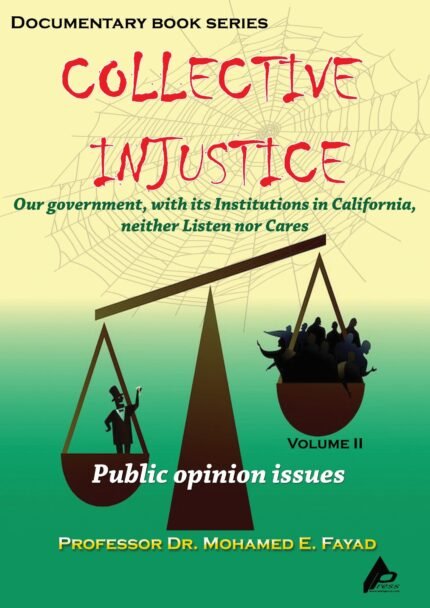
For several years, I have been trying hard to ward off collective injustice in my arena the injustice of many people and institutions, which is countless. I found no one to help me except God, Lord of the worlds. So I told myself to approach the government and its institutions, the judiciary, and lawyers, seeking help from all of them. Here, I present to them my petitions, letters, and valid evidence so that I may find among them someone who will be fair to me and remove the yoke of injustice from me. It cost me great effort, precious time, and much money, in addition to burning my nerves and deteriorating my health. My lack of resources hardly covered my daily living needs or my medical and health requirements, which prompted me to drown in many debts that exhausted me. In addition, they mistreated me when I demanded my legal rights in all my transactions and entitlements as an elderly American citizen with special needs, but no one listened or cared. It is the first volume among more than thirty-five volumes, containing between its covers all the evidence of letters and petitions showing fraud against my person, which had a disastrous effect on my work, my health, and my entire life, and my responses to all of that with irrefutable evidence
Software Engineering in The Small.
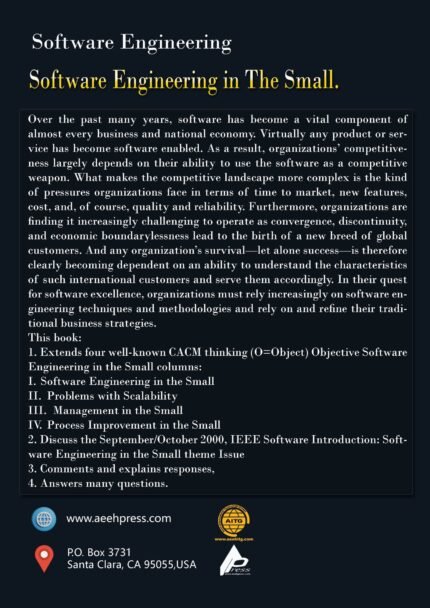
Over the past many years, software has become a vital component of almost every business and national economy. Virtually any product or service has become software enabled. As a result, organizations’ competitiveness largely depends on their ability to use the software as a competitive weapon. What makes the competitive landscape more complex is the kind of pressures organizations face in terms of time to market, new features, cost, and, of course, quality and reliability. Furthermore, organizations are finding it increasingly challenging to operate as convergence, discontinuity, and economic boundarylessness lead to the birth of a new breed of global customers. And any organization’s survival—let alone success—is therefore clearly becoming dependent on an ability to understand the characteristics of such international customers and serve them accordingly. In their quest for software excellence, organizations must rely increasingly on software engineering techniques and methodologies and rely on and refine their traditional business strategies. This book: 1. Extends four well-known CACM thinking (O=Object) Objective Software Engineering in the Small columns: I. Software Engineering in the Small II. Problems with Scalability III. Management in the Small IV. Process Improvement in the Small 2. Discuss the September/October 2000, IEEE Software Introduction: Software Engineering in the Small theme Issue 3. Comments and explains responses, 4. Answers many questions.
Software Process Development
The software/system process is the fundamental way of abstracting and implementing software/system functional and non-functional requirements, design, architectures, and software testing. Software process describes the steps required to abstract and develop some goal, usually unified skills. Software Processes transform textbook theories and method descriptions into actual action steps. It is essential to realize that processes are codified steps that describe a particular organization's way of achieving development goals. That means development processes cannot be acquired off the shelf but must be developed over time. Management must support the move to process-based development. The software process must be maintained when schedule pressures loom, or process costs initially slow some development phases. Development Processes are essential for innovation development teams, even in a well-organized group. Individuals will often perceive themselves as less skilled than before, and the routines they have established with others will undoubtedly change. Management must ensure that setting process-oriented development will allow team members to contribute positively. This book: 1. Extends four well-known CACM thinking (O=Object) Objective Software Process Development columns: I. Software Development Processes: The Necessary Evil II. Process Assessment: Considered Wasteful III. Surviving a Process Performance Crash IV. The Art of Managing Multiple Processes 2. Comments and explains responses, 3. Answers many questions. 4. Illustrates Software Development Process in three ways: Textual, Dataflow Diagram, and Activity Diagram.
Stable Analysis Patterns (SAPs) (BASE)
Software analysis patterns (SAPs) represent the enduring business themes (EBTs) concepts, show functional and non-functional requirements, ultimate design, and applicability, and play an essential role in reducing the overall cost and compressing the time of software project lifecycles. However, building stable analysis patterns is still a significant and delicate challenge. This Book proposes the novel concept of SAPs based on software stability as a modern approach for creating long-lasting, highly reusable, and widely applicable analysis patterns. This Book also aims to promote a better understanding of the problem space and discusses how to focus on requirements analysis accurately. Further, it demonstrates a new approach to discovering and creating stable analysis patterns (SAPs). A pragmatic approach is presented for understanding the problem domains, utilizing SAPs for any field of knowledge, and modeling the stable and unified foundation of EBTs, reusable components, and engines. It will help the readers attain the basic knowledge to analyze and extract analysis patterns from any domain of interest. Readers will also learn to master methods to document practices effectively, efficiently, and comprehensibly. The Book Brings significant contributions to the field of computing. This Book is a unique blend and a comprehensive reference manual on the topic of SAPs.

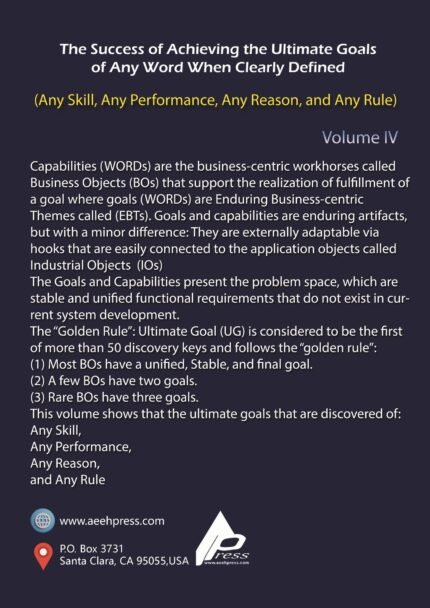
The Success of Achieving the Ultimate Goals of Any Word When Clearly Defined (Any Skill, Any Performance, Any Reason, and Any Rule)
Capabilities (WORDs) are the business-centric workhorses called Business Objects (BOs) that support the realization of fulfillment of a goal where goals (WORDs) are Enduring Business-centric Themes called (EBTs). Goals and capabilities are enduring artifacts, but with a minor difference: They are externally adaptable via hooks that are easily connected to the application objects called Industrial Objects (IOs) The Goals and Capabilities present the problem space, which are stable and unified functional requirements that do not exist in current system development. The “Golden Rule”: Ultimate Goal (UG) is considered to be the first of more than 50 discovery keys and follows the “golden rule”: (1) Most BOs have a unified, Stable, and final goal. (2) A few BOs have two goals. (3) Rare BOs have three goals. This volume shows that the ultimate goals that are discovered of: Any Skill, Any Performance, Any Reason, and Any Rule
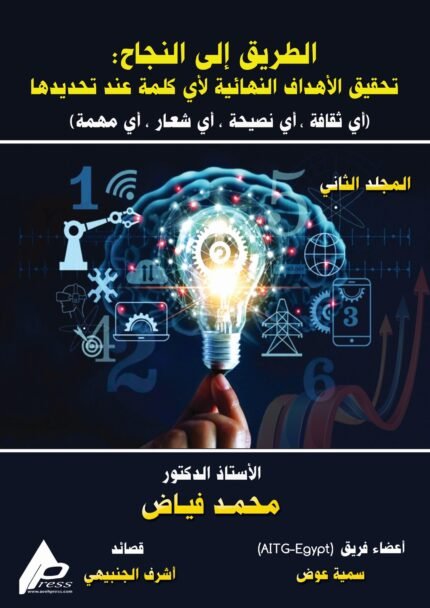

الطريق إلى النجاح: تحقيق الأهداف النهائية لأي كلمة عند تحديدها
Capabilities (WORDs) are the business-centric workhorses called Business Objects (BOs) that support the realization of fulfillment of a goal where goals (WORDs) are Enduring Business-centric Themes called (EBTs). Goals and capabilities are enduring artifacts, but with a minor difference: They are externally adaptable via hooks that are easily connected to the application objects called Industrial Objects (IOs) The Goals and Capabilities present the problem space, which are stable and unified functional requirements that do not exist in current system development. The “Golden Rule”: Ultimate Goal (UG) is considered to be the first of more than 50 discovery keys and follows the “golden rule”: (1) Most BOs have a unified, Stable, and final goal. (2) A few BOs have two goals. (3) Rare BOs have three goals. This volume shows that the ultimate goals that are discovered of: Any Culture, Any Advice, Any Slogan, and Any Task.
Reviews
There are no reviews yet.