




ويلز فارجو: رمز الإنكار واللامسؤولية بقلم : الأستاذ الدكتور محمد فياض
Price range: $8.59 through $14.99

Years of Exile (A Journey from Senbellawein to America) by Professor Dr. Mohamed E. Fayad
Price range: $9.59 through $26.99
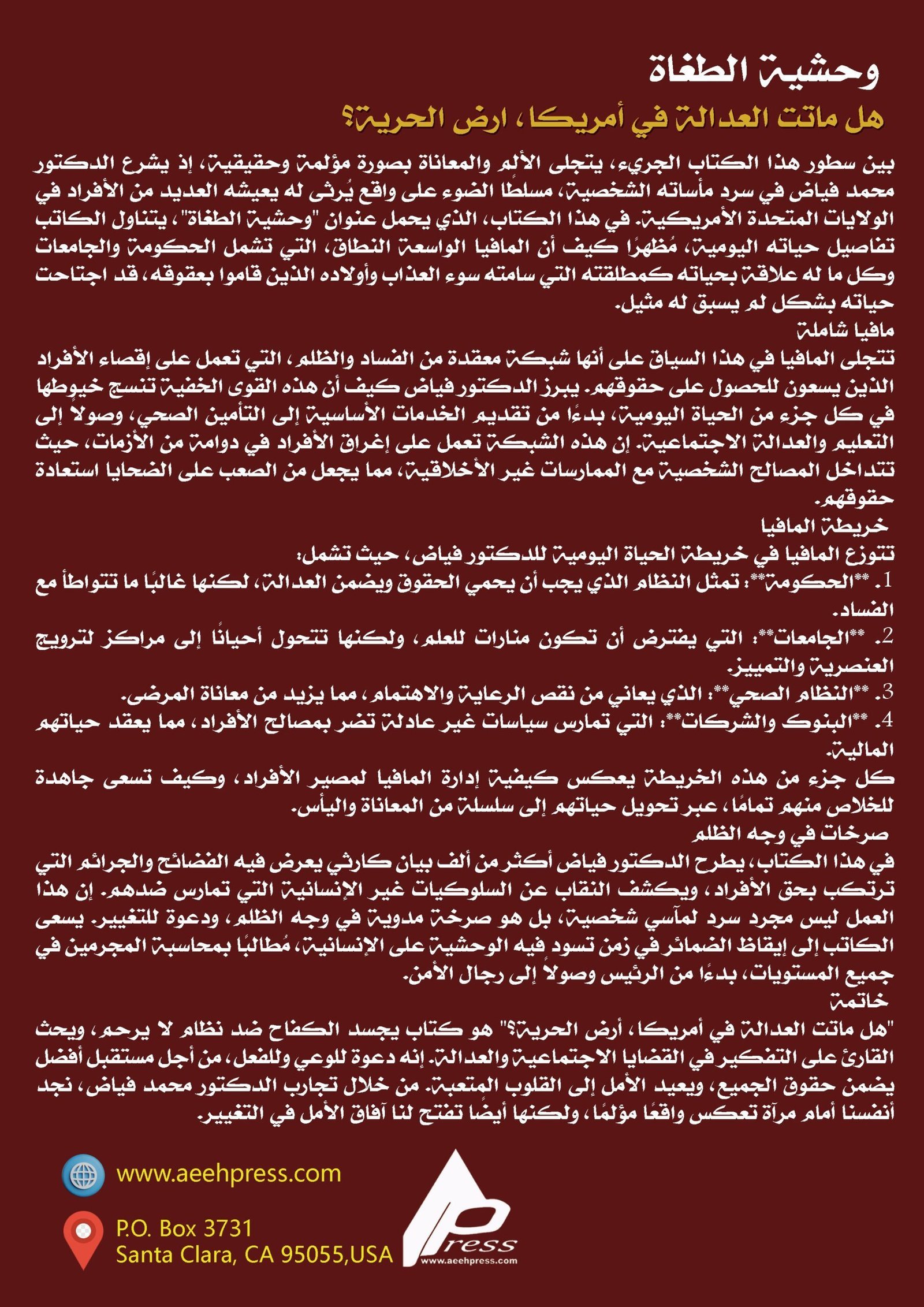
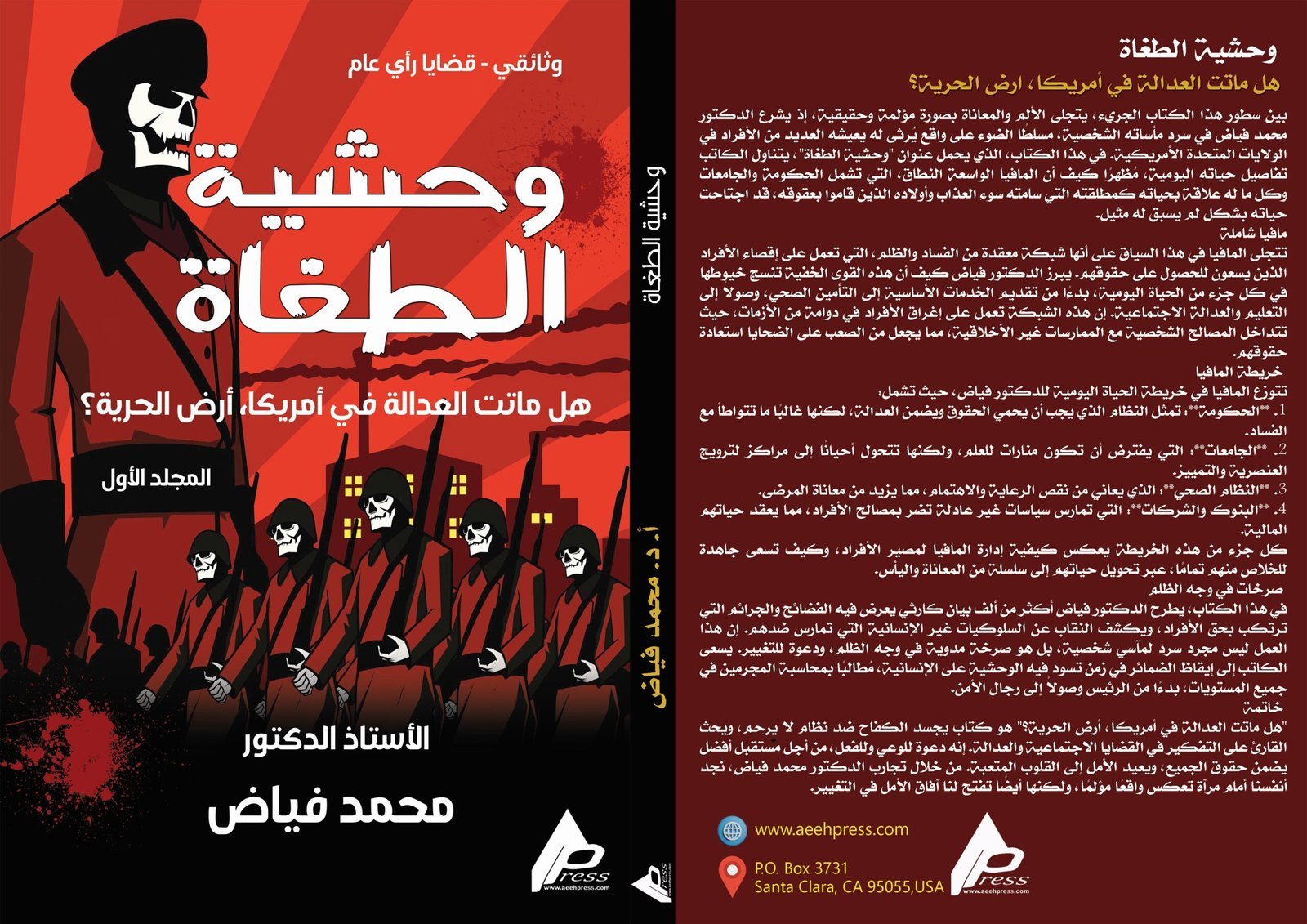
وحشية الطغاة :هل ماتت العدالة في أمريكا، ارض الحرية؟ بقلم : الأستاذ الدكتور محمد فياض
Price range: $7.59 through $16.99
In The Brutality of Tyrants, Dr. Mohamed Fayad recounts his journey through systemic injustice, racism, and corruption that profoundly impacted both his personal and professional life. His story extends beyond individual experiences, revealing public issues affecting millions of American citizens today. Dr. Fayad’s experiences within academia, healthcare, and financial institutions illustrate how individuals and systems have not only marginalized him but continue to suppress countless others. Facing deliberate negligence, exclusion, and even threats to his life, Dr. Fayad’s narrative highlights the devastating impact of institutional oppression on everyday citizens. This book is not intended to offend any person, institution, group, political party, government, or country. Rather, it is Dr. Fayad’s means of reporting his own experiences, with the hope that recounting these injustices will prevent them from happening to others. His account critiques the failure of justice in America, particularly for marginalized individuals, and underscores the urgent need for reforms across multiple sectors within the nation. The Brutality of Tyrants serves as both a personal memoir and a broader critique of institutional oppression, issuing a strong call for accountability and change in what Dr. Fayad describes as one of the greatest nations on Earth. Through his narrative, he urges readers to confront the corruption and inequality that persist in America, hoping to inspire a collective push toward a fairer, more transparent system for all.
| BOOK | Hardcover, Paperback, Kindle |
|---|
Description
Product details
-
Publisher : AEEH PRESS INC
-
Language : English
-
Paperback : 255 pages
-
ISBN-13 : 978-1-964282-88-6
-
Item Weight : 1.14 pounds
-
Dimensions : 6 x 0.68 x 9 inches
Book flyers
Copyright © 2025 AEEH PRESS INC
All Rights Reserved. No part of this publication may be reproduced, stored in a retrieval system, or transmitted, in any form or by any means, electronic, mechanical, photocopying, recording, or otherwise, without the written permission of the author.
Reviews (0)
Only logged in customers who have purchased this product may leave a review.
Shipping & Delivery


Related products
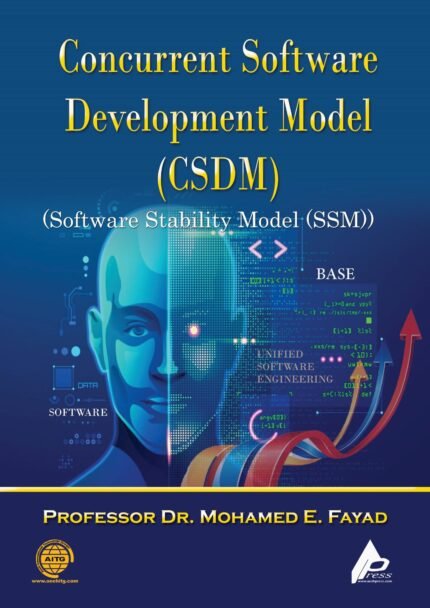
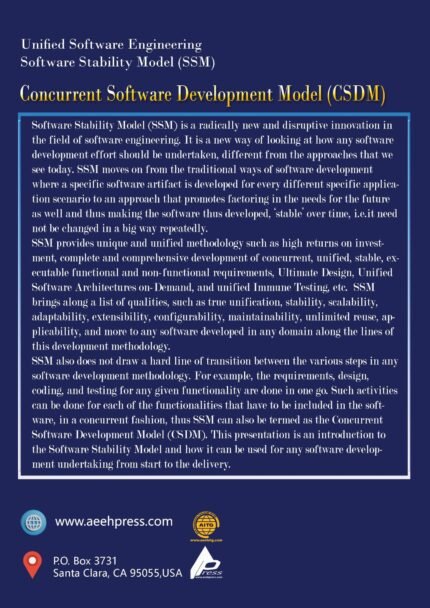
Concurrent Software Development Model (CSDM) (Software Stability Model (SSM))
Software Stability Model (SSM) is a radically new and disruptive innovation in the field of software engineering. It is a new way of looking at how any software development effort should be undertaken, different from the approaches that we see today. SSM moves on from the traditional ways of software development where a specific software artifact is developed for every different specific application scenario to an approach that promotes factoring in the needs for the future as well and thus making the software thus developed, ‘stable’ over time, i.e.it need not be changed in a big way repeatedly. SSM provides unique and unified methodology such as high returns on investment, complete and comprehensive development of concurrent, unified, stable, executable functional and non-functional requirements, Ultimate Design, Unified Software Architectures on-Demand, and unified Immune Testing, etc. SSM brings along a list of qualities, such as true unification, stability, scalability, adaptability, extensibility, configurability, maintainability, unlimited reuse, applicability, and more to any software developed in any domain along the lines of this development methodology. SSM also does not draw a hard line of transition between the various steps in any software development methodology. For example, the requirements, design, coding, and testing for any given functionality are done in one go. Such activities can be done for each of the functionalities that have to be included in the software, in a concurrent fashion, thus SSM can also be termed as the Concurrent Software Development Model (CSDM). This presentation is an introduction to the Software Stability Model and how it can be used for any software development undertaking from start to the delivery.
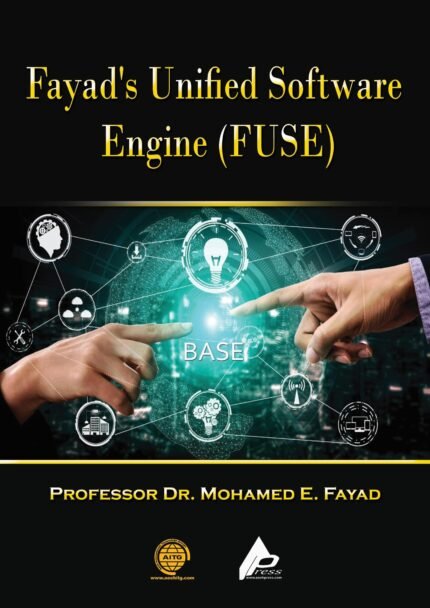
Fayad’s Unified Software Engine (FUSE)
A fuse is a standard device found in any electrical system. Examples include a home, an automobile, a power tool, and many more. The fuse itself is standard and comes in a relatively small number of variants about the required application and the amperage or load the fuse is expected to carry. For a particular application and load, fuses are typically interchangeable. If the FUSE fails, the circuit is open and will not conduct electricity. Plug in a new fuse, and the circuit is complete and resumes operation. These software programs have insidious problems, such as Lack of reliability; Lack of stability/unstable; Excessively costly (billions) to build, purchase and operate; Brittle; Software projects that continue to fail at an alarming rate; hardware dependency; maintenance nightmare; etc. The Ultimate Alternative is Fayad's Unified Software Engine (FUSE). 1) Capture the art, science, and engineering of the engine; 2) Capture and develop the engine's unified and stable functional and non-functional requirements; 3) Develop the ultimate design and unified software architecture on-demand of the engine; 4) The new and improved next generation of solutions; 5) Built on any common core infrastructure, e.g., SaaS infrastructures; 6) Facilitate on-demand, highly reusable architectures and applications with rapid times and open space to the market, starting from require ments to final product delivery; 7) Incorporating qualities such as scalability, adaptability, maintainability, unlimited reuse and applicability, and many more; 8) Stop building instance-oriented systems and reinventing the wheels; 9) Prevent hardware dependencies, etc.
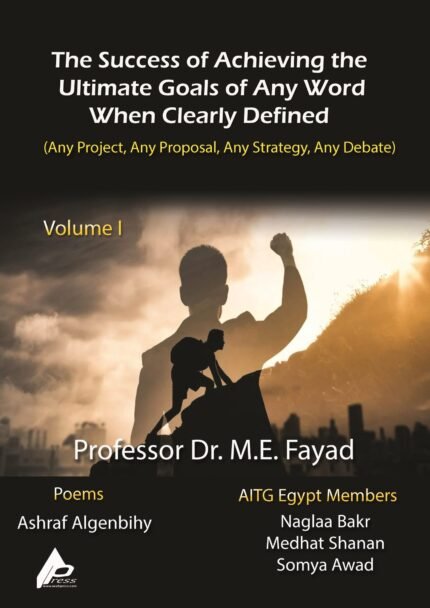
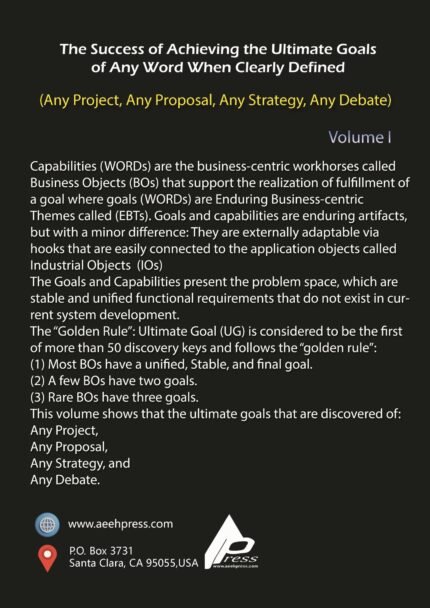
The Success of Achieving the Ultimate Goals of Any Word When Clearly Defined (Any Project, Any Proposal, Any Debate, Any Strategy)
Capabilities (WORDs) are the business-centric workhorses called Business Objects (BOs) that support the realization of fulfillment of a goal where goals (WORDs) are Enduring Business-centric Themes called (EBTs). Goals and capabilities are enduring artifacts, but with a minor difference: They are externally adaptable via hooks that are easily connected to the application objects called Industrial Objects (IOs) The Goals and Capabilities present the problem space, which are stable and unified functional requirements that do not exist in current system development. The “Golden Rule”: Ultimate Goal (UG) is considered to be the first of more than 50 discovery keys and follows the “golden rule”: (1) Most BOs have a unified, Stable, and final goal. (2) A few BOs have two goals. (3) Rare BOs have three goals. This volume shows that the ultimate goals that are discovered of: Any Project, Any Proposal, Any Strategy, and Any Debate.
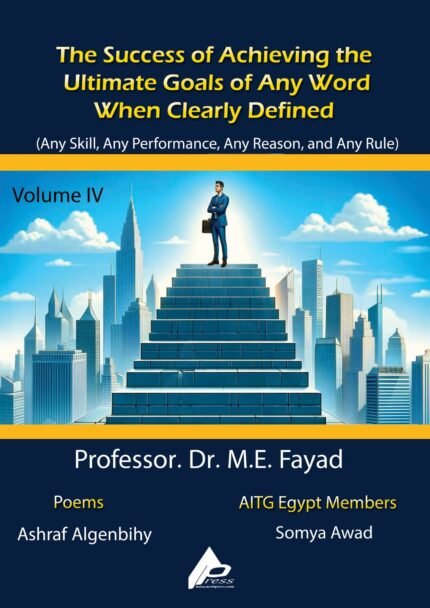
The Success of Achieving the Ultimate Goals of Any Word When Clearly Defined (Any Skill, Any Performance, Any Reason, and Any Rule)
Capabilities (WORDs) are the business-centric workhorses called Business Objects (BOs) that support the realization of fulfillment of a goal where goals (WORDs) are Enduring Business-centric Themes called (EBTs). Goals and capabilities are enduring artifacts, but with a minor difference: They are externally adaptable via hooks that are easily connected to the application objects called Industrial Objects (IOs) The Goals and Capabilities present the problem space, which are stable and unified functional requirements that do not exist in current system development. The “Golden Rule”: Ultimate Goal (UG) is considered to be the first of more than 50 discovery keys and follows the “golden rule”: (1) Most BOs have a unified, Stable, and final goal. (2) A few BOs have two goals. (3) Rare BOs have three goals. This volume shows that the ultimate goals that are discovered of: Any Skill, Any Performance, Any Reason, and Any Rule
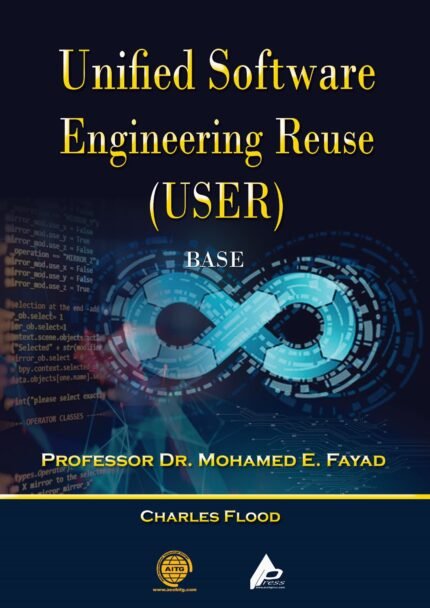
Unified Software Engineering Reuse (USER)
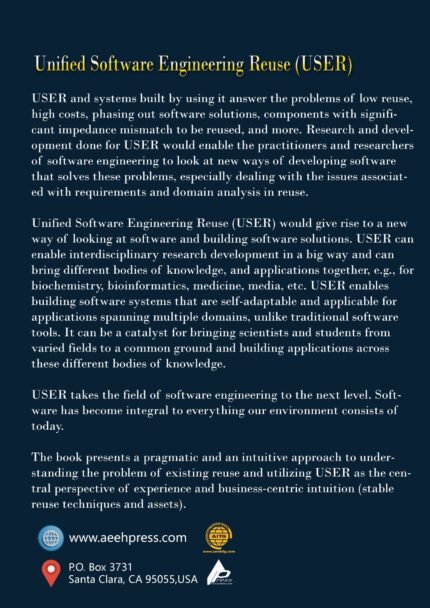
USER and systems built by using it answer the problems of low reuse, high costs, phasing out software solutions, components with significant impedance mismatch to be reused, and more. Research and development done for USER would enable the practitioners and researchers of software engineering to look at new ways of developing software that solves these problems, especially dealing with the issues associated with requirements and domain analysis in reuse. Unified Software Engineering Reuse (USER) would give rise to a new way of looking at software and building software solutions. USER can enable interdisciplinary research development in a big way and can bring different bodies of knowledge, and applications together, e.g., for biochemistry, bioinformatics, medicine, media, etc. USER enables building software systems that are self-adaptable and applicable for applications spanning multiple domains, unlike traditional software tools. It can be a catalyst for bringing scientists and students from varied fields to a common ground and building applications across these different bodies of knowledge. USER takes the field of software engineering to the next level. Software has become integral to everything our environment consists of today. The book presents a pragmatic and an intuitive approach to understanding the problem of existing reuse and utilizing USER as the central perspective of experience and business-centric intuition (stable reuse techniques and assets).

الطريق إلى النجاح: تحقيق الأهداف النهائية لأي كلمة عند تحديدها
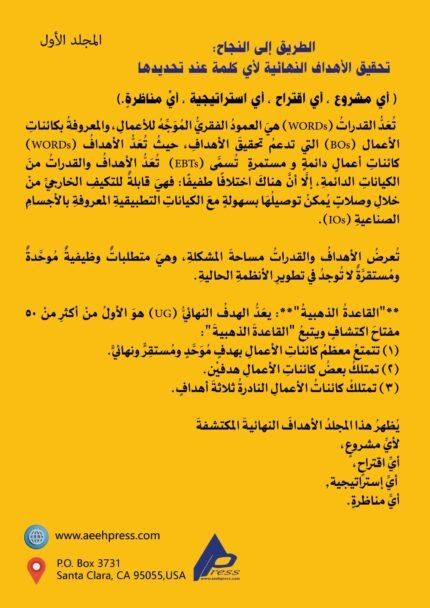
Capabilities (WORDs) are the business-centric workhorses called Business Objects (BOs) that support the realization of fulfillment of a goal where goals (WORDs) are Enduring Business-centric Themes called (EBTs). Goals and capabilities are enduring artifacts, but with a minor difference: They are externally adaptable via hooks that are easily connected to the application objects called Industrial Objects (IOs) The Goals and Capabilities present the problem space, which are stable and unified functional requirements that do not exist in current system development. The “Golden Rule”: Ultimate Goal (UG) is considered to be the first of more than 50 discovery keys and follows the “golden rule”: (1) Most BOs have a unified, Stable, and final goal. (2) A few BOs have two goals. (3) Rare BOs have three goals. This volume shows that the ultimate goals that are discovered of: Any Project, Any Proposal, Any Strategy, and Any Debate.
الطريق إلى النجاح: تحقيق الأهداف النهائية لأي كلمة عند تحديدها
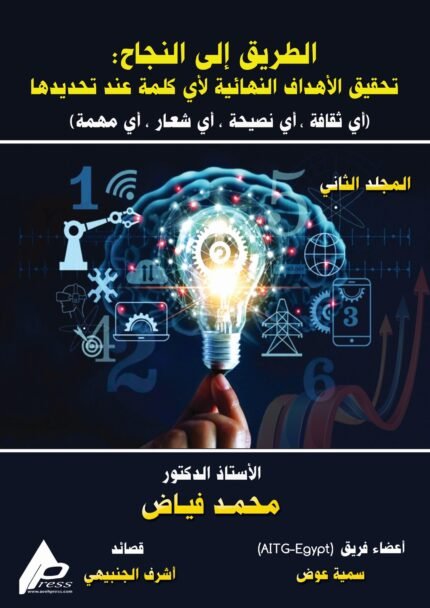
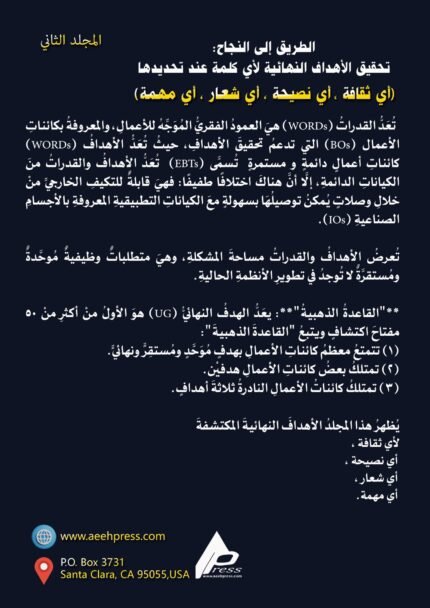
Capabilities (WORDs) are the business-centric workhorses called Business Objects (BOs) that support the realization of fulfillment of a goal where goals (WORDs) are Enduring Business-centric Themes called (EBTs). Goals and capabilities are enduring artifacts, but with a minor difference: They are externally adaptable via hooks that are easily connected to the application objects called Industrial Objects (IOs) The Goals and Capabilities present the problem space, which are stable and unified functional requirements that do not exist in current system development. The “Golden Rule”: Ultimate Goal (UG) is considered to be the first of more than 50 discovery keys and follows the “golden rule”: (1) Most BOs have a unified, Stable, and final goal. (2) A few BOs have two goals. (3) Rare BOs have three goals. This volume shows that the ultimate goals that are discovered of: Any Culture, Any Advice, Any Slogan, and Any Task.
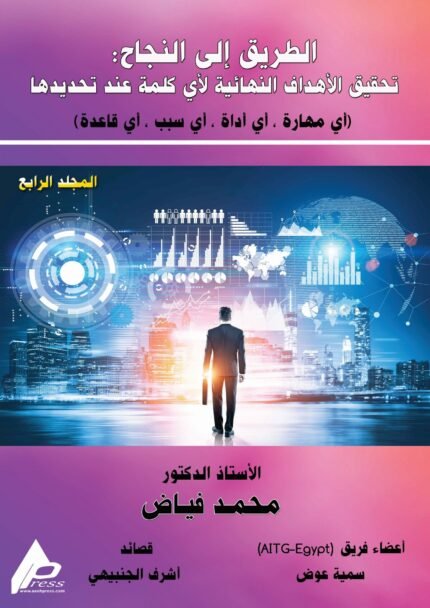
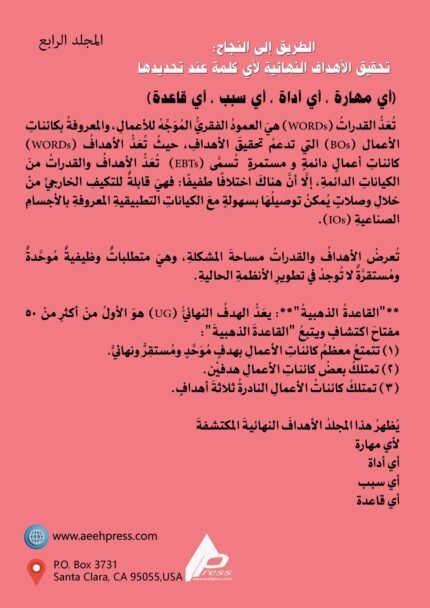
الطريق إلى النجاح: تحقيق الأهداف النهائية لأي كلمة عند تحديدها
Capabilities (WORDs) are the business-centric workhorses called Business Objects (BOs) that support the realization of fulfillment of a goal where goals (WORDs) are Enduring Business-centric Themes called (EBTs). Goals and capabilities are enduring artifacts, but with a minor difference: They are externally adaptable via hooks that are easily connected to the application objects called Industrial Objects (IOs) The Goals and Capabilities present the problem space, which are stable and unified functional requirements that do not exist in current system development. The “Golden Rule”: Ultimate Goal (UG) is considered to be the first of more than 50 discovery keys and follows the “golden rule”: (1) Most BOs have a unified, Stable, and final goal. (2) A few BOs have two goals. (3) Rare BOs have three goals. This volume shows that the ultimate goals that are discovered of: Any Skill, Any Performance, Any Reason, and Any Rule
Reviews
There are no reviews yet.