



Our California government and its institutions neither Listen nor Care by Dr. M.E. Fayad
Price range: $7.59 through $15.99

The Success of Achieving the Ultimate Goals of Any Word When Clearly Defined (Any Culture, Any Advice, Any Slogan, and Any Task )
Price range: $69.59 through $199.59
The Success of Achieving the Ultimate Goals of Any Word When Clearly Defined (Any Project, Any Proposal, Any Debate, Any Strategy)
Price range: $69.59 through $199.59
Capabilities (WORDs) are the business-centric workhorses called Business Objects (BOs) that support the realization of fulfillment of a goal where goals (WORDs) are Enduring Business-centric Themes called (EBTs). Goals and capabilities are enduring artifacts, but with a minor difference: They are externally adaptable via hooks that are easily connected to the application objects called Industrial Objects (IOs) The Goals and Capabilities present the problem space, which are stable and unified functional requirements that do not exist in current system development. The “Golden Rule”: Ultimate Goal (UG) is considered to be the first of more than 50 discovery keys and follows the “golden rule”: (1) Most BOs have a unified, Stable, and final goal. (2) A few BOs have two goals. (3) Rare BOs have three goals. This volume shows that the ultimate goals that are discovered of: Any Project, Any Proposal, Any Strategy, and Any Debate.
| BOOK | Hardcover, Paperback, Kindle |
|---|
Description
Product details
-
Publisher : AEEH PRESS INC (April 13, 2024)
-
Language : English
-
Paperback : 255 pages
-
ISBN-13 : 978-1-964282-32-9
-
Item Weight : 1.14 pounds
-
Dimensions : 6 x 0.68 x 9 inches
-
Poems Ashraf Algenbihy
-
Illustrations by Mahmoud Asaad
-
Calligrapher and language editor Kamal Saad
Book flyers
Copyright © 2025 AEEH PRESS INC
All Rights Reserved. No part of this publication may be reproduced, stored in a retrieval system, or transmitted, in any form or by any means, electronic, mechanical, photocopying, recording, or otherwise, without the written permission of the author.
Reviews (0)
Only logged in customers who have purchased this product may leave a review.
Shipping & Delivery


Related products
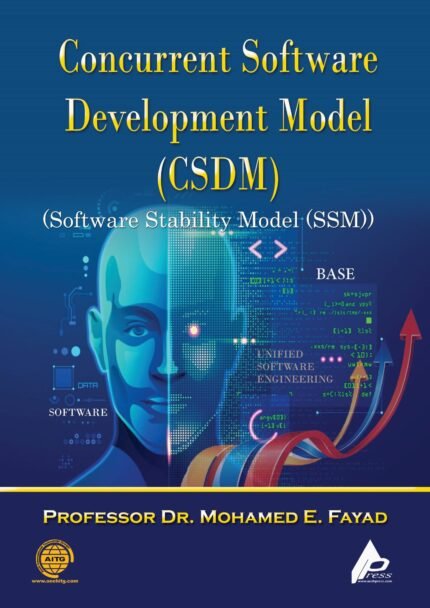
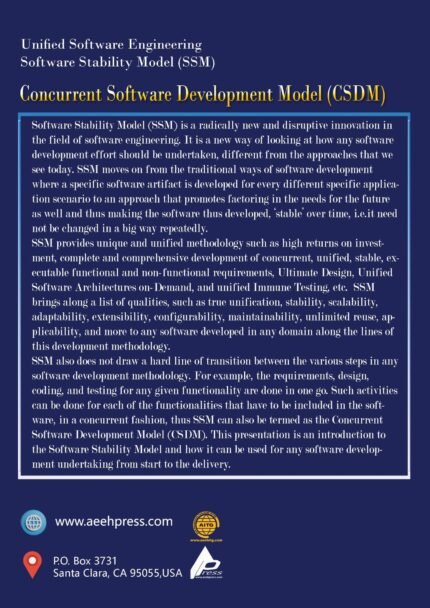
Concurrent Software Development Model (CSDM) (Software Stability Model (SSM))
Software Stability Model (SSM) is a radically new and disruptive innovation in the field of software engineering. It is a new way of looking at how any software development effort should be undertaken, different from the approaches that we see today. SSM moves on from the traditional ways of software development where a specific software artifact is developed for every different specific application scenario to an approach that promotes factoring in the needs for the future as well and thus making the software thus developed, ‘stable’ over time, i.e.it need not be changed in a big way repeatedly. SSM provides unique and unified methodology such as high returns on investment, complete and comprehensive development of concurrent, unified, stable, executable functional and non-functional requirements, Ultimate Design, Unified Software Architectures on-Demand, and unified Immune Testing, etc. SSM brings along a list of qualities, such as true unification, stability, scalability, adaptability, extensibility, configurability, maintainability, unlimited reuse, applicability, and more to any software developed in any domain along the lines of this development methodology. SSM also does not draw a hard line of transition between the various steps in any software development methodology. For example, the requirements, design, coding, and testing for any given functionality are done in one go. Such activities can be done for each of the functionalities that have to be included in the software, in a concurrent fashion, thus SSM can also be termed as the Concurrent Software Development Model (CSDM). This presentation is an introduction to the Software Stability Model and how it can be used for any software development undertaking from start to the delivery.

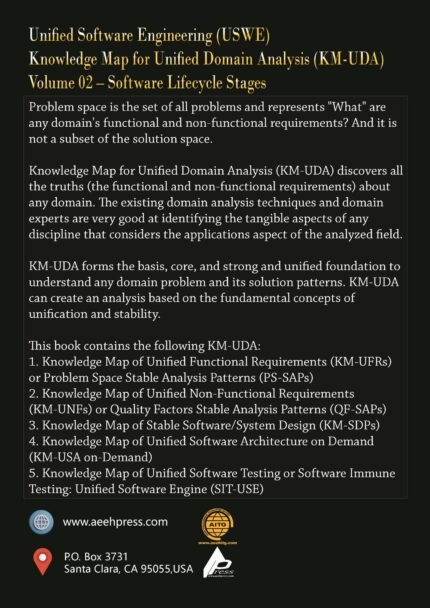
Knowledge Map for Unified Domain Analysis (KM-UDA) Volume 02 – Software Lifecycle Stages
Problem space is the set of all problems and represents "What" are any domain's functional and non-functional requirements? And it is not a subset of the solution space. Knowledge Map for Unified Domain Analysis (KM-UDA) discovers all the truths (the functional and non-functional requirements) about any domain. The existing domain analysis techniques and domain experts are very good at identifying the tangible aspects of any discipline that considers the applications aspect of the analyzed field. KM-UDA forms the basis, core, and strong and unified foundation to understand any domain problem and its solution patterns. KM-UDA can create an analysis based on the fundamental concepts of unification and stability. This book contains the following KM-UDA: 1. Knowledge Map of Unified Functional Requirements (KM-UFRs) or Problem Space Stable Analysis Patterns (PS-SAPs) 2. Knowledge Map of Unified Non-Functional Requirements (KM-UNFs) or Quality Factors Stable Analysis Patterns (QF-SAPs) 3. Knowledge Map of Stable Software/System Design (KM-SDPs) 4. Knowledge Map of Unified Software Architecture on Demand (KM-USA on-Demand) 5. Knowledge Map of Unified Software Testing or Software Immune Testing: Unified Software Engine (SIT-USE)
Software Process Development
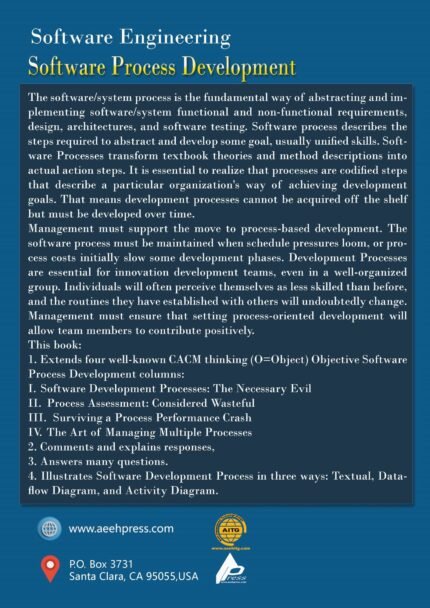
The software/system process is the fundamental way of abstracting and implementing software/system functional and non-functional requirements, design, architectures, and software testing. Software process describes the steps required to abstract and develop some goal, usually unified skills. Software Processes transform textbook theories and method descriptions into actual action steps. It is essential to realize that processes are codified steps that describe a particular organization's way of achieving development goals. That means development processes cannot be acquired off the shelf but must be developed over time. Management must support the move to process-based development. The software process must be maintained when schedule pressures loom, or process costs initially slow some development phases. Development Processes are essential for innovation development teams, even in a well-organized group. Individuals will often perceive themselves as less skilled than before, and the routines they have established with others will undoubtedly change. Management must ensure that setting process-oriented development will allow team members to contribute positively. This book: 1. Extends four well-known CACM thinking (O=Object) Objective Software Process Development columns: I. Software Development Processes: The Necessary Evil II. Process Assessment: Considered Wasteful III. Surviving a Process Performance Crash IV. The Art of Managing Multiple Processes 2. Comments and explains responses, 3. Answers many questions. 4. Illustrates Software Development Process in three ways: Textual, Dataflow Diagram, and Activity Diagram.
The Success of Achieving the Ultimate Goals of Any Word When Clearly Defined (Any Skill, Any Performance, Any Reason, and Any Rule)
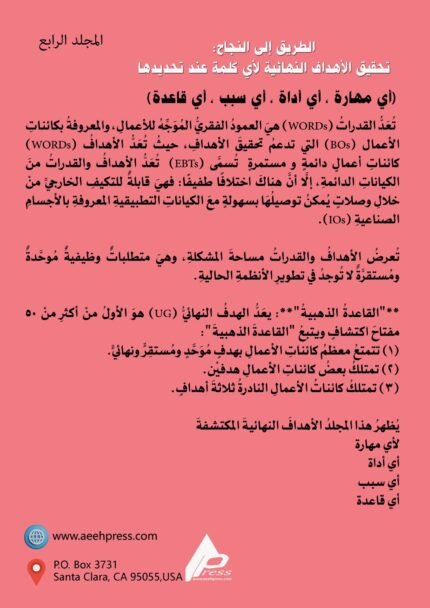
Capabilities (WORDs) are the business-centric workhorses called Business Objects (BOs) that support the realization of fulfillment of a goal where goals (WORDs) are Enduring Business-centric Themes called (EBTs). Goals and capabilities are enduring artifacts, but with a minor difference: They are externally adaptable via hooks that are easily connected to the application objects called Industrial Objects (IOs) The Goals and Capabilities present the problem space, which are stable and unified functional requirements that do not exist in current system development. The “Golden Rule”: Ultimate Goal (UG) is considered to be the first of more than 50 discovery keys and follows the “golden rule”: (1) Most BOs have a unified, Stable, and final goal. (2) A few BOs have two goals. (3) Rare BOs have three goals. This volume shows that the ultimate goals that are discovered of: Any Skill, Any Performance, Any Reason, and Any Rule
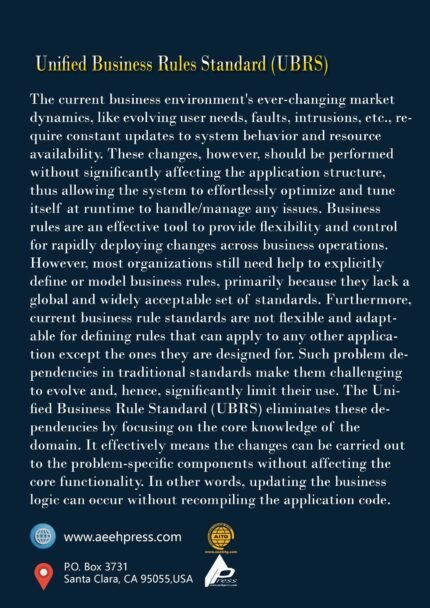
Unified Business Rules Standard (UBRS)
The current business environment's ever-changing market dynamics, like evolving user needs, faults, intrusions, etc., require constant updates to system behavior and resource availability. These changes, however, should be performed without significantly affecting the application structure, thus allowing the system to effortlessly optimize and tune itself at runtime to handle/manage any issues. Business rules are an effective tool to provide flexibility and control for rapidly deploying changes across business operations. However, most organizations still need help to explicitly define or model business rules, primarily because they lack a global and widely acceptable set of standards. Furthermore, current business rule standards are not flexible and adaptable for defining rules that can apply to any other application except the ones they are designed for. Such problem dependencies in traditional standards make them challenging to evolve and, hence, significantly limit their use. The Unified Business Rule Standard (UBRS) eliminates these dependencies by focusing on the core knowledge of the domain. It effectively means the changes can be carried out to the problem-specific components without affecting the core functionality. In other words, updating the business logic can occur without recompiling the application code.
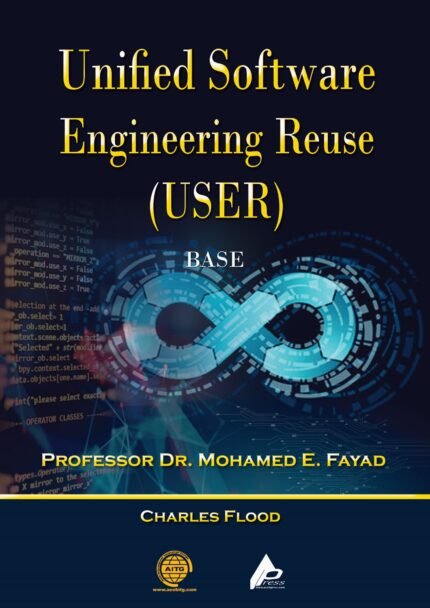
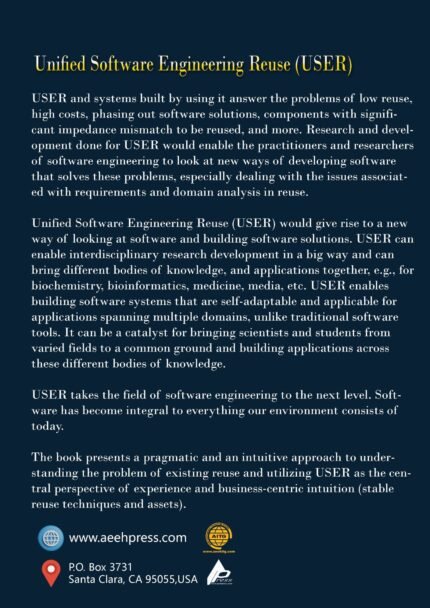
Unified Software Engineering Reuse (USER)
USER and systems built by using it answer the problems of low reuse, high costs, phasing out software solutions, components with significant impedance mismatch to be reused, and more. Research and development done for USER would enable the practitioners and researchers of software engineering to look at new ways of developing software that solves these problems, especially dealing with the issues associated with requirements and domain analysis in reuse. Unified Software Engineering Reuse (USER) would give rise to a new way of looking at software and building software solutions. USER can enable interdisciplinary research development in a big way and can bring different bodies of knowledge, and applications together, e.g., for biochemistry, bioinformatics, medicine, media, etc. USER enables building software systems that are self-adaptable and applicable for applications spanning multiple domains, unlike traditional software tools. It can be a catalyst for bringing scientists and students from varied fields to a common ground and building applications across these different bodies of knowledge. USER takes the field of software engineering to the next level. Software has become integral to everything our environment consists of today. The book presents a pragmatic and an intuitive approach to understanding the problem of existing reuse and utilizing USER as the central perspective of experience and business-centric intuition (stable reuse techniques and assets).

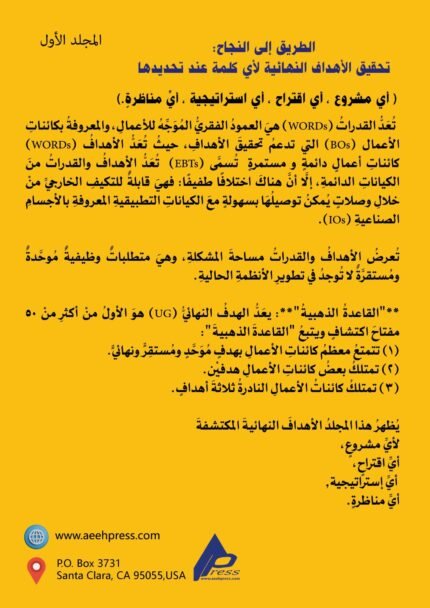
الطريق إلى النجاح: تحقيق الأهداف النهائية لأي كلمة عند تحديدها
Capabilities (WORDs) are the business-centric workhorses called Business Objects (BOs) that support the realization of fulfillment of a goal where goals (WORDs) are Enduring Business-centric Themes called (EBTs). Goals and capabilities are enduring artifacts, but with a minor difference: They are externally adaptable via hooks that are easily connected to the application objects called Industrial Objects (IOs) The Goals and Capabilities present the problem space, which are stable and unified functional requirements that do not exist in current system development. The “Golden Rule”: Ultimate Goal (UG) is considered to be the first of more than 50 discovery keys and follows the “golden rule”: (1) Most BOs have a unified, Stable, and final goal. (2) A few BOs have two goals. (3) Rare BOs have three goals. This volume shows that the ultimate goals that are discovered of: Any Project, Any Proposal, Any Strategy, and Any Debate.
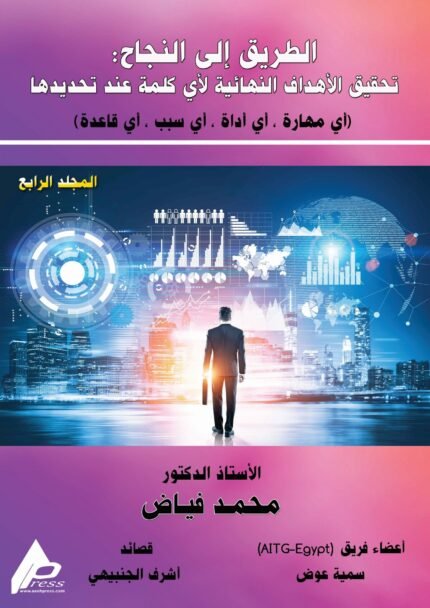
الطريق إلى النجاح: تحقيق الأهداف النهائية لأي كلمة عند تحديدها
Capabilities (WORDs) are the business-centric workhorses called Business Objects (BOs) that support the realization of fulfillment of a goal where goals (WORDs) are Enduring Business-centric Themes called (EBTs). Goals and capabilities are enduring artifacts, but with a minor difference: They are externally adaptable via hooks that are easily connected to the application objects called Industrial Objects (IOs) The Goals and Capabilities present the problem space, which are stable and unified functional requirements that do not exist in current system development. The “Golden Rule”: Ultimate Goal (UG) is considered to be the first of more than 50 discovery keys and follows the “golden rule”: (1) Most BOs have a unified, Stable, and final goal. (2) A few BOs have two goals. (3) Rare BOs have three goals. This volume shows that the ultimate goals that are discovered of: Any Skill, Any Performance, Any Reason, and Any Rule
Reviews
There are no reviews yet.