



Software Process Development
Price range: $69.99 through $149.99

The Tale of an Egyptian with an American Passport by Professor Dr. Mohamed E. Fayad
Price range: $9.59 through $19.99
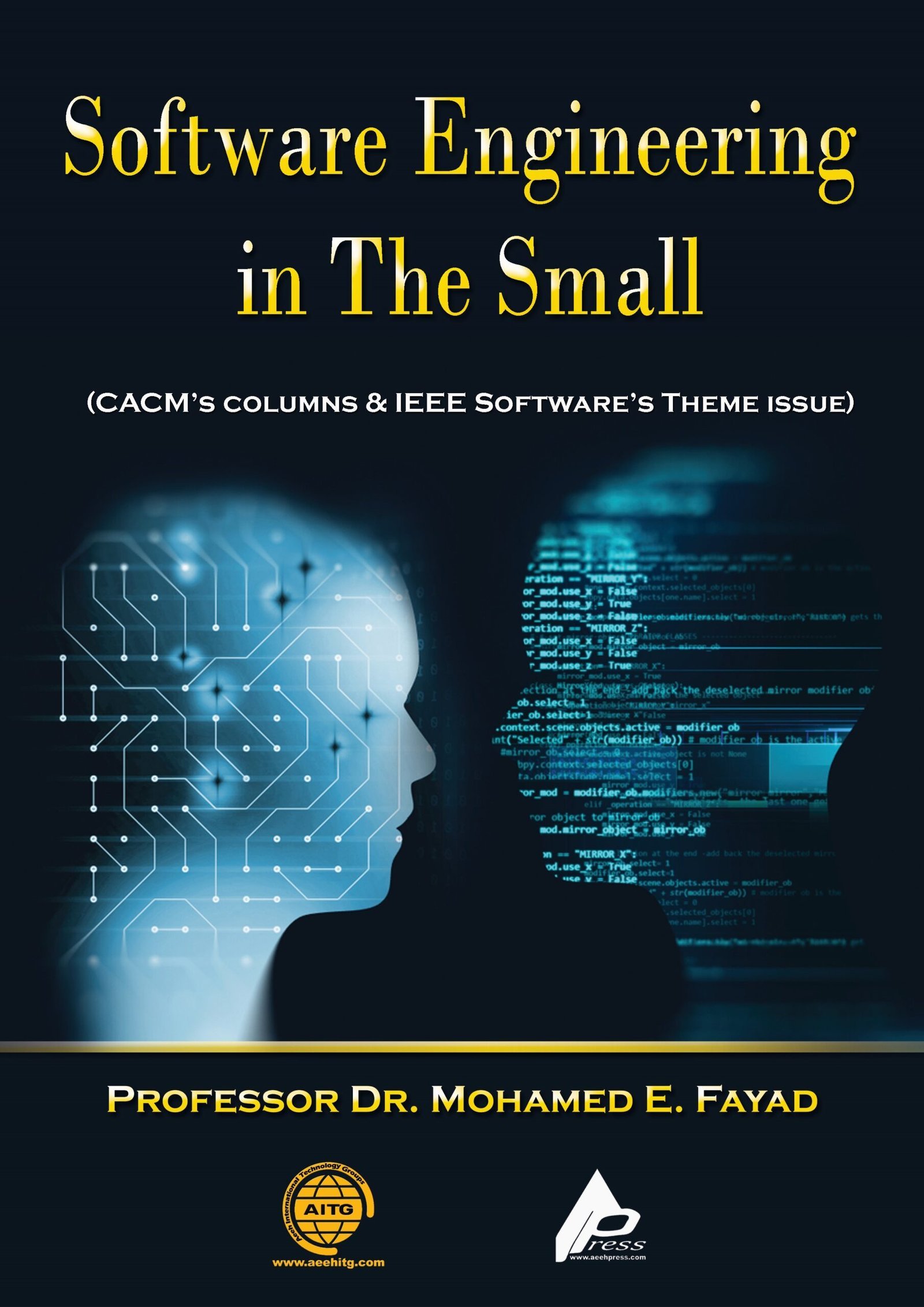
Software Engineering in The Small.
Price range: $69.99 through $149.99
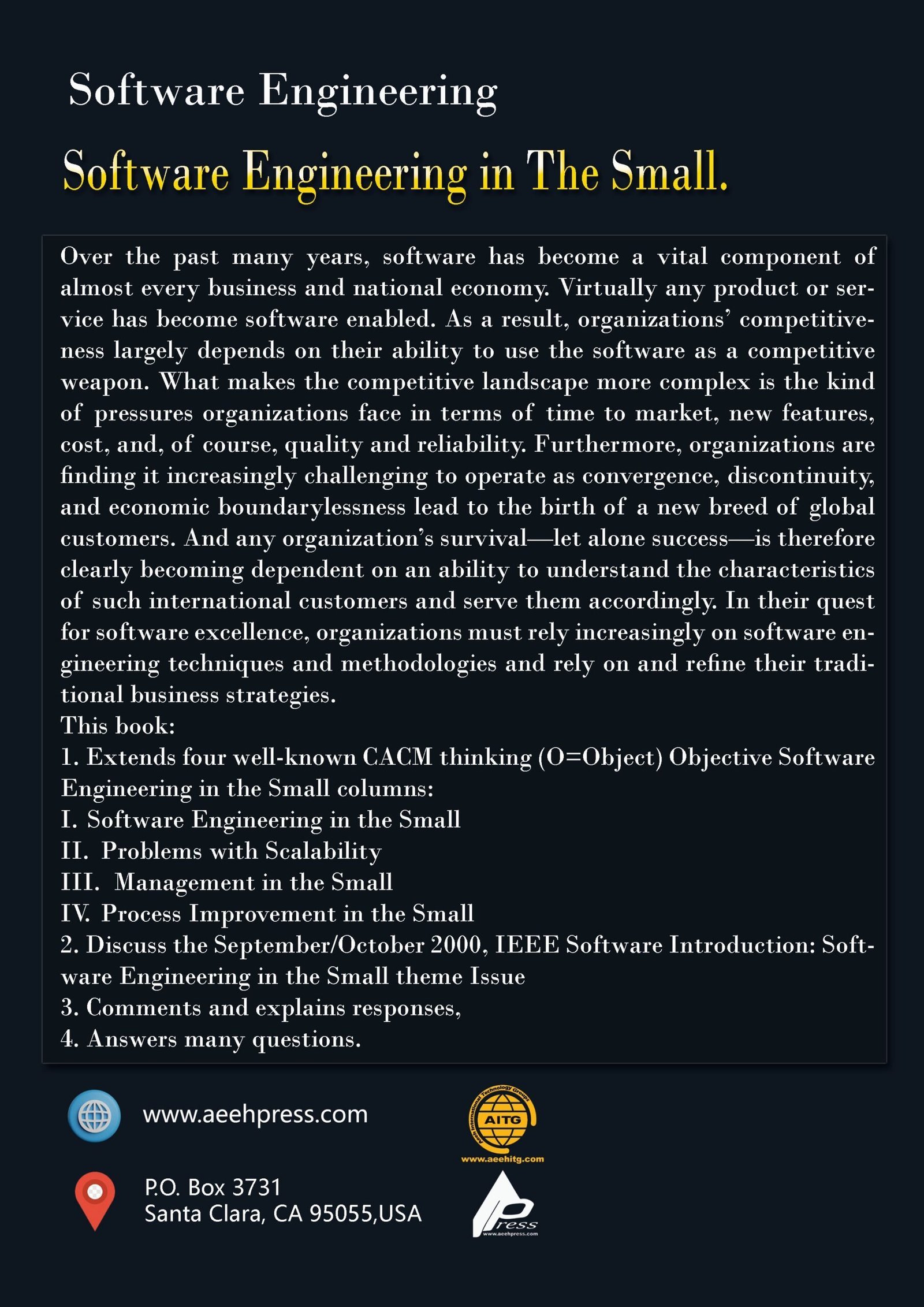
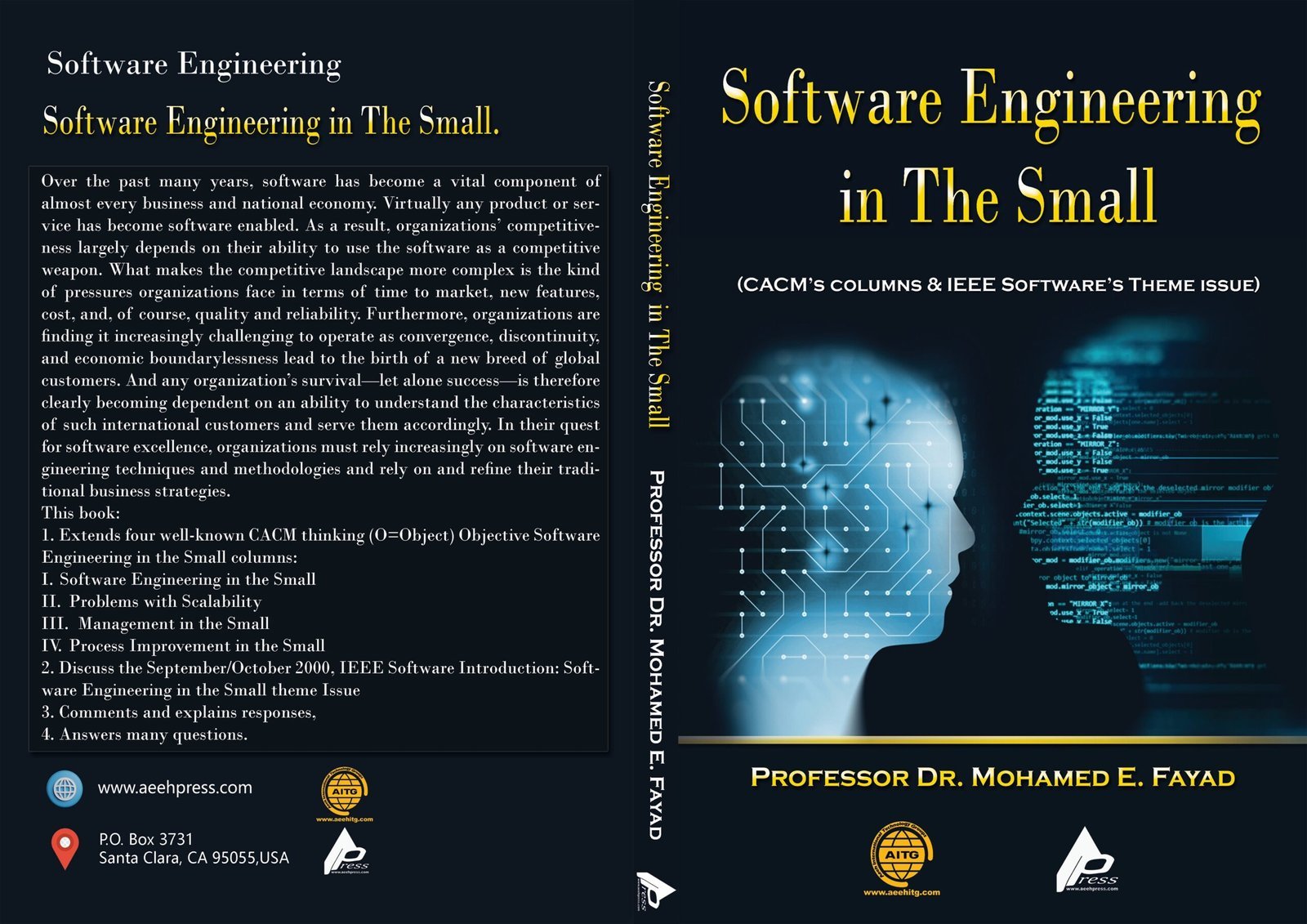
Over the past many years, software has become a vital component of almost every business and national economy. Virtually any product or service has become software enabled. As a result, organizations’ competitiveness largely depends on their ability to use the software as a competitive weapon. What makes the competitive landscape more complex is the kind of pressures organizations face in terms of time to market, new features, cost, and, of course, quality and reliability. Furthermore, organizations are finding it increasingly challenging to operate as convergence, discontinuity, and economic boundarylessness lead to the birth of a new breed of global customers. And any organization’s survival—let alone success—is therefore clearly becoming dependent on an ability to understand the characteristics of such international customers and serve them accordingly. In their quest for software excellence, organizations must rely increasingly on software engineering techniques and methodologies and rely on and refine their traditional business strategies. This book: 1. Extends four well-known CACM thinking (O=Object) Objective Software Engineering in the Small columns: I. Software Engineering in the Small II. Problems with Scalability III. Management in the Small IV. Process Improvement in the Small 2. Discuss the September/October 2000, IEEE Software Introduction: Software Engineering in the Small theme Issue 3. Comments and explains responses, 4. Answers many questions.
| BOOK | Hardcover, Paperback, Kindle |
|---|
Description
Product details
-
Publisher : AEEH PRESS INC
-
Language : English
-
ISBN 978-1-964282-56-5
-
Item Weight : 1.14 pounds
-
Dimensions : 6 x 0.68 x 9 inches
-
Illustrations by Mahmoud Asaad
-
Release Date: August 2025 or before
-
Number of Pages – between 350 to 450 pages
-
Author: Professor Dr. Mohamed E. Fayad
Book flyers
Book Press releases
Copyright © 2025 AEEH PRESS INC
All Rights Reserved. No part of this publication may be reproduced, stored in a retrieval system, or transmitted, in any form or by any means, electronic, mechanical, photocopying, recording, or otherwise, without the written permission of the author.
Reviews (0)
Only logged in customers who have purchased this product may leave a review.
Shipping & Delivery


Related products

Knowledge Map for Unified Domain Analysis (KM-UDA) Volume 02 – Software Lifecycle Stages
Problem space is the set of all problems and represents "What" are any domain's functional and non-functional requirements? And it is not a subset of the solution space. Knowledge Map for Unified Domain Analysis (KM-UDA) discovers all the truths (the functional and non-functional requirements) about any domain. The existing domain analysis techniques and domain experts are very good at identifying the tangible aspects of any discipline that considers the applications aspect of the analyzed field. KM-UDA forms the basis, core, and strong and unified foundation to understand any domain problem and its solution patterns. KM-UDA can create an analysis based on the fundamental concepts of unification and stability. This book contains the following KM-UDA: 1. Knowledge Map of Unified Functional Requirements (KM-UFRs) or Problem Space Stable Analysis Patterns (PS-SAPs) 2. Knowledge Map of Unified Non-Functional Requirements (KM-UNFs) or Quality Factors Stable Analysis Patterns (QF-SAPs) 3. Knowledge Map of Stable Software/System Design (KM-SDPs) 4. Knowledge Map of Unified Software Architecture on Demand (KM-USA on-Demand) 5. Knowledge Map of Unified Software Testing or Software Immune Testing: Unified Software Engine (SIT-USE)
Software Process Development
The software/system process is the fundamental way of abstracting and implementing software/system functional and non-functional requirements, design, architectures, and software testing. Software process describes the steps required to abstract and develop some goal, usually unified skills. Software Processes transform textbook theories and method descriptions into actual action steps. It is essential to realize that processes are codified steps that describe a particular organization's way of achieving development goals. That means development processes cannot be acquired off the shelf but must be developed over time. Management must support the move to process-based development. The software process must be maintained when schedule pressures loom, or process costs initially slow some development phases. Development Processes are essential for innovation development teams, even in a well-organized group. Individuals will often perceive themselves as less skilled than before, and the routines they have established with others will undoubtedly change. Management must ensure that setting process-oriented development will allow team members to contribute positively. This book: 1. Extends four well-known CACM thinking (O=Object) Objective Software Process Development columns: I. Software Development Processes: The Necessary Evil II. Process Assessment: Considered Wasteful III. Surviving a Process Performance Crash IV. The Art of Managing Multiple Processes 2. Comments and explains responses, 3. Answers many questions. 4. Illustrates Software Development Process in three ways: Textual, Dataflow Diagram, and Activity Diagram.
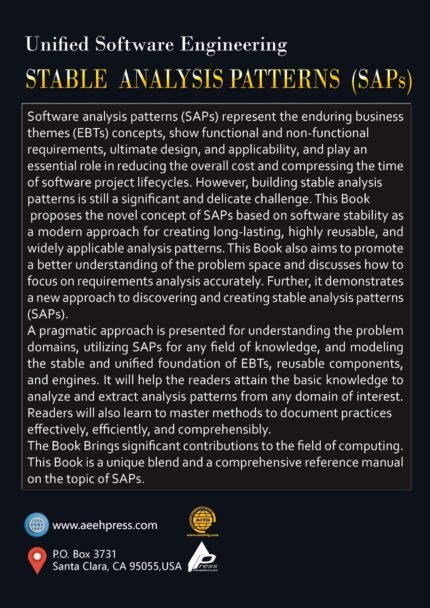
Stable Analysis Patterns (SAPs) (BASE)
Software analysis patterns (SAPs) represent the enduring business themes (EBTs) concepts, show functional and non-functional requirements, ultimate design, and applicability, and play an essential role in reducing the overall cost and compressing the time of software project lifecycles. However, building stable analysis patterns is still a significant and delicate challenge. This Book proposes the novel concept of SAPs based on software stability as a modern approach for creating long-lasting, highly reusable, and widely applicable analysis patterns. This Book also aims to promote a better understanding of the problem space and discusses how to focus on requirements analysis accurately. Further, it demonstrates a new approach to discovering and creating stable analysis patterns (SAPs). A pragmatic approach is presented for understanding the problem domains, utilizing SAPs for any field of knowledge, and modeling the stable and unified foundation of EBTs, reusable components, and engines. It will help the readers attain the basic knowledge to analyze and extract analysis patterns from any domain of interest. Readers will also learn to master methods to document practices effectively, efficiently, and comprehensibly. The Book Brings significant contributions to the field of computing. This Book is a unique blend and a comprehensive reference manual on the topic of SAPs.

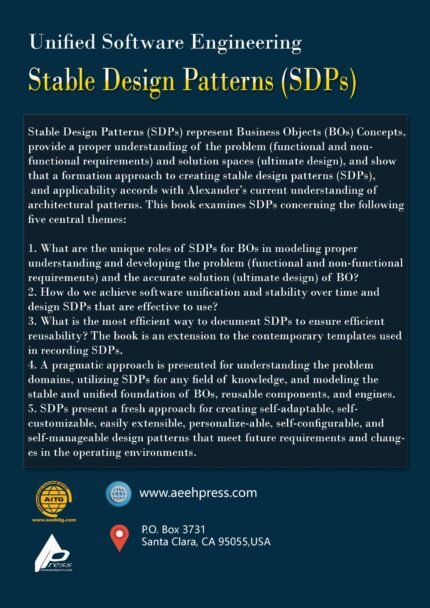
Stable Design Patterns (SDPs)(BASE)
Stable Design Patterns (SDPs) represent Business Objects (BOs) Concepts, provide a proper understanding of the problem (functional and non- functional requirements) and solution spaces (ultimate design), and show that a formation approach to creating stable design patterns (SDPs), and applicability accords with Alexander’s current understanding of architectural patterns. This book examines SDPs concerning the following five central themes: 1. What are the unique roles of SDPs for BOs in modeling proper understanding and developing the problem (functional and non-functional requirements) and the accurate solution (ultimate design) of BO? 2. How do we achieve software unification and stability over time and design SDPs that are effective to use? 3. What is the most efficient way to document SDPs to ensure efficient reusability? The book is an extension to the contemporary templates used in recording SDPs. 4. A pragmatic approach is presented for understanding the problem domains, utilizing SDPs for any field of knowledge, and modeling the stable and unified foundation of BOs, reusable components, and engines. 5. SDPs present a fresh approach for creating self-adaptable, self- customizable, easily extensible, personalize-able, self-configurable, and self-manageable design patterns that meet future requirements and changes in the operating environments.

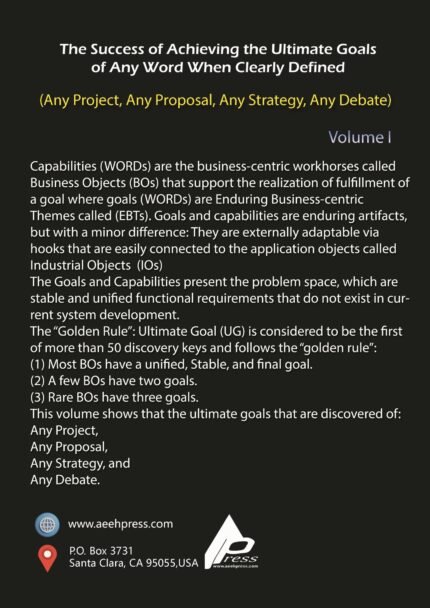
The Success of Achieving the Ultimate Goals of Any Word When Clearly Defined (Any Project, Any Proposal, Any Debate, Any Strategy)
Capabilities (WORDs) are the business-centric workhorses called Business Objects (BOs) that support the realization of fulfillment of a goal where goals (WORDs) are Enduring Business-centric Themes called (EBTs). Goals and capabilities are enduring artifacts, but with a minor difference: They are externally adaptable via hooks that are easily connected to the application objects called Industrial Objects (IOs) The Goals and Capabilities present the problem space, which are stable and unified functional requirements that do not exist in current system development. The “Golden Rule”: Ultimate Goal (UG) is considered to be the first of more than 50 discovery keys and follows the “golden rule”: (1) Most BOs have a unified, Stable, and final goal. (2) A few BOs have two goals. (3) Rare BOs have three goals. This volume shows that the ultimate goals that are discovered of: Any Project, Any Proposal, Any Strategy, and Any Debate.

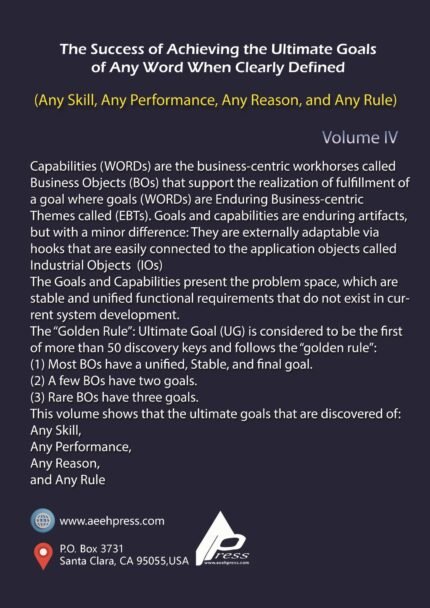
The Success of Achieving the Ultimate Goals of Any Word When Clearly Defined (Any Skill, Any Performance, Any Reason, and Any Rule)
Capabilities (WORDs) are the business-centric workhorses called Business Objects (BOs) that support the realization of fulfillment of a goal where goals (WORDs) are Enduring Business-centric Themes called (EBTs). Goals and capabilities are enduring artifacts, but with a minor difference: They are externally adaptable via hooks that are easily connected to the application objects called Industrial Objects (IOs) The Goals and Capabilities present the problem space, which are stable and unified functional requirements that do not exist in current system development. The “Golden Rule”: Ultimate Goal (UG) is considered to be the first of more than 50 discovery keys and follows the “golden rule”: (1) Most BOs have a unified, Stable, and final goal. (2) A few BOs have two goals. (3) Rare BOs have three goals. This volume shows that the ultimate goals that are discovered of: Any Skill, Any Performance, Any Reason, and Any Rule


الطريق إلى النجاح: تحقيق الأهداف النهائية لأي كلمة عند تحديدها
Capabilities (WORDs) are the business-centric workhorses called Business Objects (BOs) that support the realization of fulfillment of a goal where goals (WORDs) are Enduring Business-centric Themes called (EBTs). Goals and capabilities are enduring artifacts, but with a minor difference: They are externally adaptable via hooks that are easily connected to the application objects called Industrial Objects (IOs) The Goals and Capabilities present the problem space, which are stable and unified functional requirements that do not exist in current system development. The “Golden Rule”: Ultimate Goal (UG) is considered to be the first of more than 50 discovery keys and follows the “golden rule”: (1) Most BOs have a unified, Stable, and final goal. (2) A few BOs have two goals. (3) Rare BOs have three goals. This volume shows that the ultimate goals that are discovered of: Any Project, Any Proposal, Any Strategy, and Any Debate.


الطريق إلى النجاح: تحقيق الأهداف النهائية لأي كلمة عند تحديدها
Capabilities (WORDs) are the business-centric workhorses called Business Objects (BOs) that support the realization of fulfillment of a goal where goals (WORDs) are Enduring Business-centric Themes called (EBTs). Goals and capabilities are enduring artifacts, but with a minor difference: They are externally adaptable via hooks that are easily connected to the application objects called Industrial Objects (IOs) The Goals and Capabilities present the problem space, which are stable and unified functional requirements that do not exist in current system development. The “Golden Rule”: Ultimate Goal (UG) is considered to be the first of more than 50 discovery keys and follows the “golden rule”: (1) Most BOs have a unified, Stable, and final goal. (2) A few BOs have two goals. (3) Rare BOs have three goals. This volume shows that the ultimate goals that are discovered of: Any Skill, Any Performance, Any Reason, and Any Rule
Reviews
There are no reviews yet.