






Knowledge Map for Unified Domain Analysis (KM-UDA) Volume 01 – Intelligence Technologies
Price range: $99.99 through $199.99

Software Process Development
Price range: $69.99 through $149.99
Knowledge Map for Unified Domain Analysis (KM-UDA) Volume 02 – Software Lifecycle Stages
Price range: $99.99 through $199.99
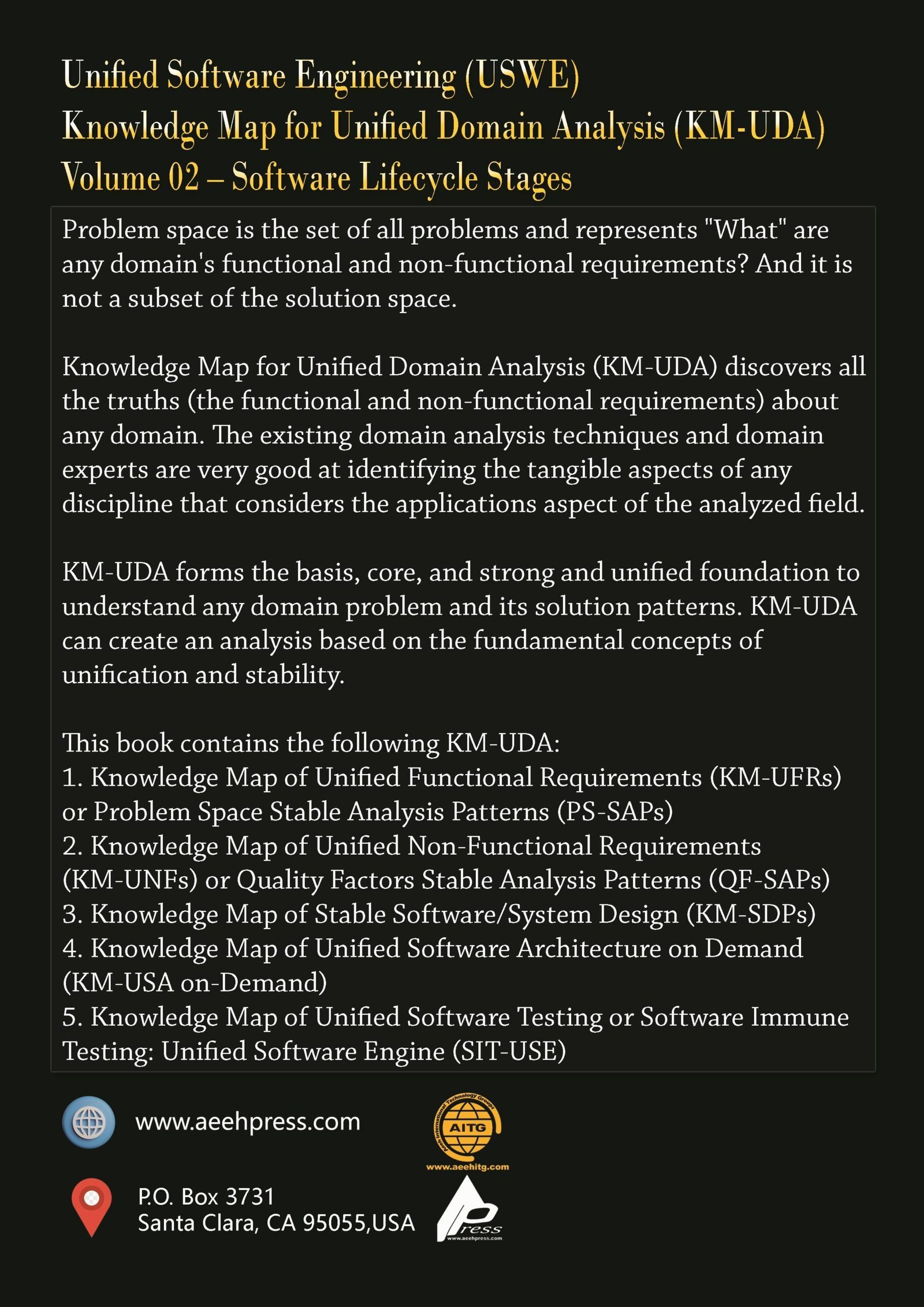
Problem space is the set of all problems and represents “What” are any domain’s functional and non-functional requirements? And it is not a subset of the solution space. Knowledge Map for Unified Domain Analysis (KM-UDA) discovers all the truths (the functional and non-functional requirements) about any domain. The existing domain analysis techniques and domain experts are very good at identifying the tangible aspects of any discipline that considers the applications aspect of the analyzed field. KM-UDA forms the basis, core, and strong and unified foundation to understand any domain problem and its solution patterns. KM-UDA can create an analysis based on the fundamental concepts of unification and stability. This book contains the following KM-UDA: 1. Knowledge Map of Unified Functional Requirements (KM-UFRs) or Problem Space Stable Analysis Patterns (PS-SAPs) 2. Knowledge Map of Unified Non-Functional Requirements (KM-UNFs) or Quality Factors Stable Analysis Patterns (QF-SAPs) 3. Knowledge Map of Stable Software/System Design (KM-SDPs) 4. Knowledge Map of Unified Software Architecture on Demand (KM-USA on-Demand) 5. Knowledge Map of Unified Software Testing or Software Immune Testing: Unified Software Engine (SIT-USE)
| BOOK | Hardcover, Paperback, Kindle |
|---|
Description
Product details
-
Publisher : AEEH PRESS INC
-
Language : English
-
ISBN :
978-1-964282-52-7
-
Item Weight : 1.14 pounds
-
Dimensions : 6 x 0.68 x 9 inches
-
Illustrations by Mahmoud Asaad
-
Release Date: August 2025 or before
-
Number of Pages – between 350 to 450 pages
-
Author: Professor Dr. Mohamed E. Fayad
Book flyers
Book Press releases
Copyright © 2025 AEEH PRESS INC
All Rights Reserved. No part of this publication may be reproduced, stored in a retrieval system, or transmitted, in any form or by any means, electronic, mechanical, photocopying, recording, or otherwise, without the written permission of the author.
Reviews (0)
Only logged in customers who have purchased this product may leave a review.
Shipping & Delivery


Related products

Knowledge Map for Unified Domain Analysis (KM-UDA) Volume 01 – Intelligence Technologies
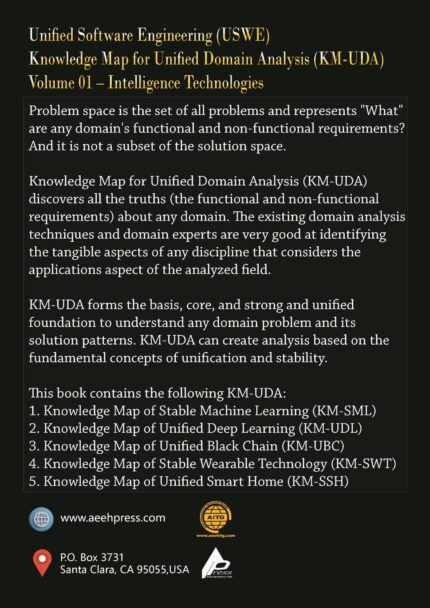
Problem space is the set of all problems and represents "What" are any domain's functional and non-functional requirements? And it is not a subset of the solution space. Knowledge Map for Unified Domain Analysis (KM-UDA) discovers all the truths (the functional and non-functional requirements) about any domain. The existing domain analysis techniques and domain experts are very good at identifying the tangible aspects of any discipline that considers the applications aspect of the analyzed field. KM-UDA forms the basis, core, and strong and unified foundation to understand any domain problem and its solution patterns. KM-UDA can create analysis based on the fundamental concepts of unification and stability. This book contains the following KM-UDA: 1. Knowledge Map of Stable Machine Learning (KM-SML) 2. Knowledge Map of Unified Deep Learning (KM-UDL) 3. Knowledge Map of Unified Black Chain (KM-UBC) 4. Knowledge Map of Stable Wearable Technology (KM-SWT) 5. Knowledge Map of Unified Smart Home (KM-SSH)
Stable Analysis Patterns (SAPs) (BASE)
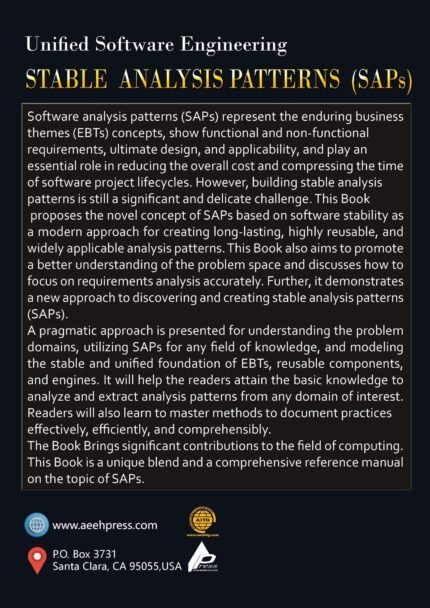
Software analysis patterns (SAPs) represent the enduring business themes (EBTs) concepts, show functional and non-functional requirements, ultimate design, and applicability, and play an essential role in reducing the overall cost and compressing the time of software project lifecycles. However, building stable analysis patterns is still a significant and delicate challenge. This Book proposes the novel concept of SAPs based on software stability as a modern approach for creating long-lasting, highly reusable, and widely applicable analysis patterns. This Book also aims to promote a better understanding of the problem space and discusses how to focus on requirements analysis accurately. Further, it demonstrates a new approach to discovering and creating stable analysis patterns (SAPs). A pragmatic approach is presented for understanding the problem domains, utilizing SAPs for any field of knowledge, and modeling the stable and unified foundation of EBTs, reusable components, and engines. It will help the readers attain the basic knowledge to analyze and extract analysis patterns from any domain of interest. Readers will also learn to master methods to document practices effectively, efficiently, and comprehensibly. The Book Brings significant contributions to the field of computing. This Book is a unique blend and a comprehensive reference manual on the topic of SAPs.


The Brutality of Tyrants – First Volume by Dr. M.E. Fayad,
In The Brutality of Tyrants, Dr. Mohamed Fayad recounts his journey through systemic injustice, racism, and corruption that profoundly impacted both his personal and professional life. His story extends beyond individual experiences, revealing public issues affecting millions of American citizens today. Dr. Fayad’s experiences within academia, healthcare, and financial institutions illustrate how individuals and systems have not only marginalized him but continue to suppress countless others. Facing deliberate negligence, exclusion, and even threats to his life, Dr. Fayad’s narrative highlights the devastating impact of institutional oppression on everyday citizens. This book is not intended to offend any person, institution, group, political party, government, or country. Rather, it is Dr. Fayad’s means of reporting his own experiences, with the hope that recounting these injustices will prevent them from happening to others. His account critiques the failure of justice in America, particularly for marginalized individuals, and underscores the urgent need for reforms across multiple sectors within the nation. The Brutality of Tyrants serves as both a personal memoir and a broader critique of institutional oppression, issuing a strong call for accountability and change in what Dr. Fayad describes as one of the greatest nations on Earth. Through his narrative, he urges readers to confront the corruption and inequality that persist in America, hoping to inspire a collective push toward a fairer, more transparent system for all.

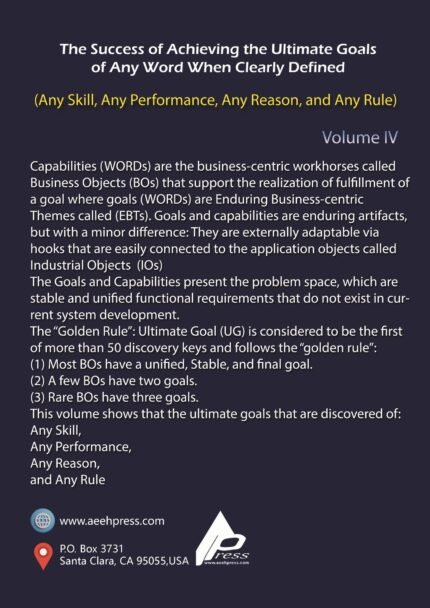
The Success of Achieving the Ultimate Goals of Any Word When Clearly Defined (Any Skill, Any Performance, Any Reason, and Any Rule)
Capabilities (WORDs) are the business-centric workhorses called Business Objects (BOs) that support the realization of fulfillment of a goal where goals (WORDs) are Enduring Business-centric Themes called (EBTs). Goals and capabilities are enduring artifacts, but with a minor difference: They are externally adaptable via hooks that are easily connected to the application objects called Industrial Objects (IOs) The Goals and Capabilities present the problem space, which are stable and unified functional requirements that do not exist in current system development. The “Golden Rule”: Ultimate Goal (UG) is considered to be the first of more than 50 discovery keys and follows the “golden rule”: (1) Most BOs have a unified, Stable, and final goal. (2) A few BOs have two goals. (3) Rare BOs have three goals. This volume shows that the ultimate goals that are discovered of: Any Skill, Any Performance, Any Reason, and Any Rule


Wells Fargo: a symbol of denial and irresponsibility by Dr. Mohamed E. Fayad
Credit Bureaus and Financial InsWells Fargo: a symbol of denial and irresponsibility I became at the end of my rope after my rights were lost, my reputation was tarnished, and my financial and social situation was weak when my ex-wife seized the opportunity to open two accounts at Wells Fargo Bank without my knowledge in 2012. Moreover, in collaboration with a bank employee, she forged my signature during my illness and heart transplant in July 2016. My ex-wife kept withdrawing large sums of money from those accounts. After discovering the two accounts in 2018, they were closed. As a result, this matter left a bad reputation in my financial situation and significantly harmed me. Due to this, I fell into significant problems, including being deprived of financial transactions with the bank and being refused any requests I submitted. Moreover, funding sources stopped, and many of my projects stopped with them. My request to open an account for my publishing house was denied despite having all the necessary legal papers. Then, I submitted complaints to the bank to investigate the matter, primarily related to the crime of forging my signature. Still, the case has not been decided so far, and my complaint has not been answered nor investigated as if I were screaming in a desert where no one responded to my call or felt my suffering. The ugliest thing is the inhumane treatment that the bank employees at Wells Fargo used to deal with me. The bank took arbitrary measures against me and my commercial accounts and regularly disbursed vast sums of money to several institutions without my consent. The bank deliberately spent vast sums of money on my ex-wife, who withdrew my savings and money without my permission and knowledge, not to mention the mistreatment by the bank employees. titutions are nothing but Vindictive Bureaus. I have suffered a lot from the mistreatment of companies, banks, credit bureaus, and Wells Fargo, which I think colluded with the bank I deal with and deliberately destroyed my financial reputation and all my business, which negatively affected all my activities and deprived me of my economic rights by publishing false information about me to all financial institutions and all parties that need a financial report on me. In the last six years, I have compiled a complete record of all credit companies and their offices, due to which I wasted a lot of time contacting all of them on the phone and writing correspondence to them. However, they didn't help me with anything. Moreover, I didn't get any support from them to compensate me for what I suffered, like severe losses and damages, and they unjustly robbed me of money. Please consider these allegations of mine because they are tough. You can check the evidence attached to the book, which includes the latest information about my bank and credit cards and contains many errors and contradictions. I am tired of being rejected and unwarrantedly mistreated by all banks.

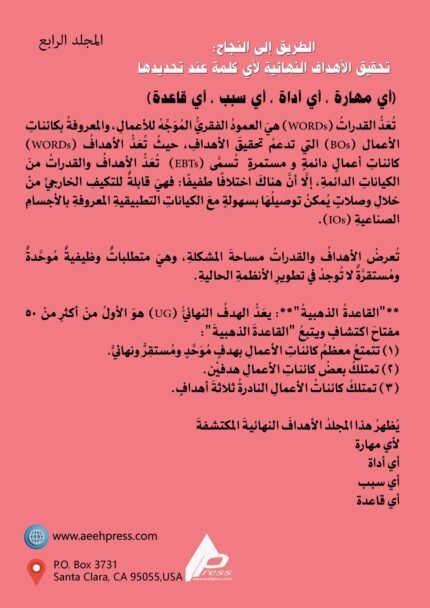
الطريق إلى النجاح: تحقيق الأهداف النهائية لأي كلمة عند تحديدها
Capabilities (WORDs) are the business-centric workhorses called Business Objects (BOs) that support the realization of fulfillment of a goal where goals (WORDs) are Enduring Business-centric Themes called (EBTs). Goals and capabilities are enduring artifacts, but with a minor difference: They are externally adaptable via hooks that are easily connected to the application objects called Industrial Objects (IOs) The Goals and Capabilities present the problem space, which are stable and unified functional requirements that do not exist in current system development. The “Golden Rule”: Ultimate Goal (UG) is considered to be the first of more than 50 discovery keys and follows the “golden rule”: (1) Most BOs have a unified, Stable, and final goal. (2) A few BOs have two goals. (3) Rare BOs have three goals. This volume shows that the ultimate goals that are discovered of: Any Skill, Any Performance, Any Reason, and Any Rule


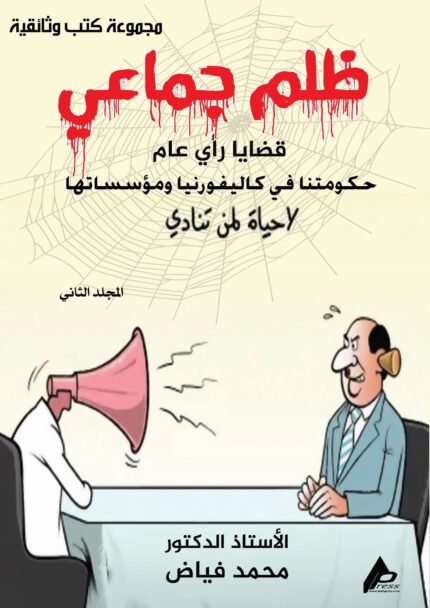
حكاية مصري بجواز سفر أمريكي بقلم : الأستاذ الدكتور محمد فياض
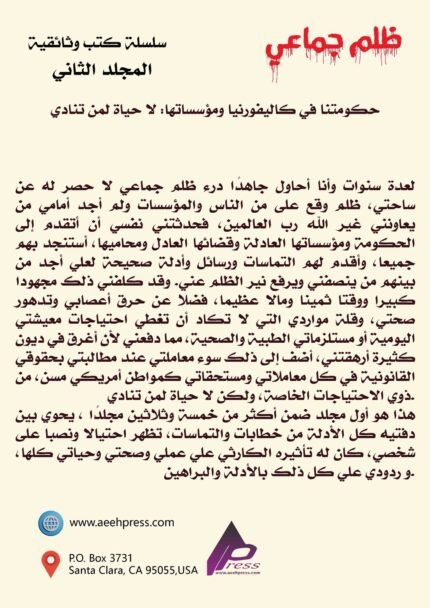
I am an American of Egyptian descent, a university professor, scientist, and founder of some new sciences. I am 72 years old, a resident of San Jose, and a lover of all humanity. However, my company and I have long suffered from collective injustices from most people and organizations I deal with. I am facing disastrous problems and severe obstacles in my work and private life, as if this is an intentional thing and a systematic campaign against me and all the innovators and their companies in Egypt, America, and the Arab countries in general. People, communities, and organizations must unite worldwide to do good and help those in need. However, unfortunately, many people and man y governmental and civil organizations join and gather to do me wrong as if they find pleasure in it, whether in the USA or Egypt, as if they were enjoying my pain, getting high while sipping from my flowing blood in full cups, and eating at the table of my tragedy as if only they were at their last supper. It seems that these problems I suffer from also affect all startups and their founders, as injustice has spread, justice is missing, conscience is dead, and morals are lost. If all these abuses are against me only, then I reluctantly accept them. However, suppose they extend to affect the human community as a whole. In that case, we must stand up and combat this injustice and resist the hateful racism that destroyed the dreams of millions of people, including me. Should we, as a human society, wait for the advent of another Martin Luther King, waging wars to end racism and injustice to all human beings? In Your Hands is a book from a series that depicts my tragedy and personal experience. I deposited my grievances between its covers to be read by every person with a lively conscience, an enlightened mind, and a heart that beats with truth and goodness. This is to relieve me of the injustice that has befallen me and restore some of my lost rights. If you have the same experience and suffer from the same tragedy, please get in touch with me to unite to eliminate the injustice against you and my startup companies. We are the basis of renaissance, civilization, and development worldwide.
Reviews
There are no reviews yet.