






The Brutality of Tyrants – First Volume by Dr. M.E. Fayad,
Price range: $8.59 through $18.99

The Success of Achieving the Ultimate Goals of Any Word When Clearly Defined (Any Project, Any Proposal, Any Debate, Any Strategy)
Price range: $69.59 through $199.59
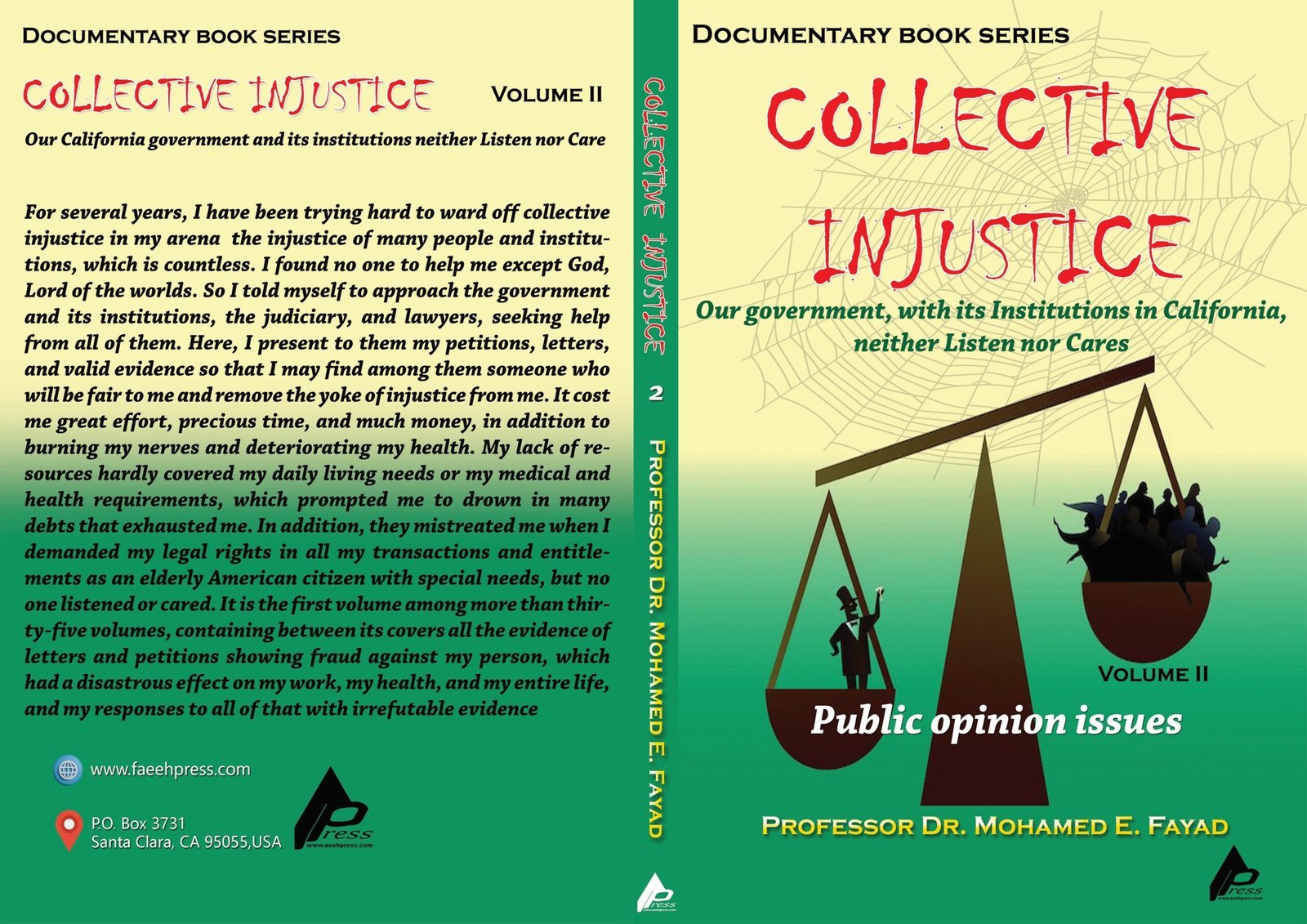
Our California government and its institutions neither Listen nor Care by Dr. M.E. Fayad
Price range: $7.59 through $15.99
For several years, I have been trying hard to ward off collective injustice in my arena the injustice of many people and institutions, which is countless. I found no one to help me except God, Lord of the worlds. So I told myself to approach the government and its institutions, the judiciary, and lawyers, seeking help from all of them. Here, I present to them my petitions, letters, and valid evidence so that I may find among them someone who will be fair to me and remove the yoke of injustice from me. It cost me great effort, precious time, and much money, in addition to burning my nerves and deteriorating my health. My lack of resources hardly covered my daily living needs or my medical and health requirements, which prompted me to drown in many debts that exhausted me. In addition, they mistreated me when I demanded my legal rights in all my transactions and entitlements as an elderly American citizen with special needs, but no one listened or cared. It is the first volume among more than thirty-five volumes, containing between its covers all the evidence of letters and petitions showing fraud against my person, which had a disastrous effect on my work, my health, and my entire life, and my responses to all of that with irrefutable evidence
| BOOK | Hardcover, Paperback, Kindle |
|---|
Description
Product details
-
Publisher : AEEH PRESS INC (April 13, 2024)
-
Language : English
-
Paperback : 255 pages
-
ISBN-13 : 978-1-964282-69-5
-
Item Weight : 1.14 pounds
-
Dimensions : 6 x 0.68 x 9 inches
Book flyers
Copyright © 2025 AEEH PRESS INC
All Rights Reserved. No part of this publication may be reproduced, stored in a retrieval system, or transmitted, in any form or by any means, electronic, mechanical, photocopying, recording, or otherwise, without the written permission of the author.
Reviews (0)
Only logged in customers who have purchased this product may leave a review.
Shipping & Delivery


Related products
Avana San Jose & Monticello Apartments in Santa Clara: The Tenant who is the Landlord’s Victim by Dr. Mohamed E. Fayad
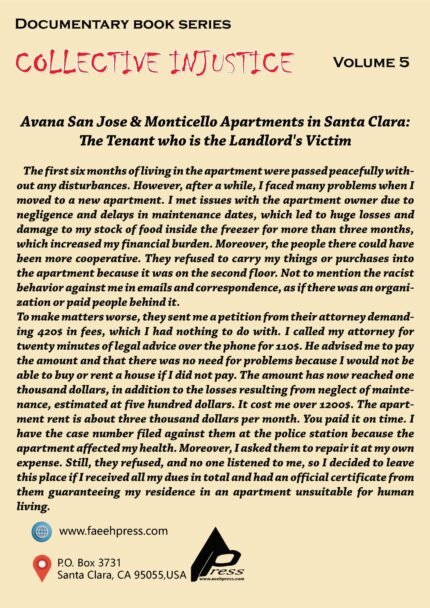
Avana San Jose & Monticello Apartments in Santa Clara: The Tenant who is the Landlord's Victim The first six months of living in the apartment were passed peacefully without any disturbances. However, after a while, I faced many problems when I moved to a new apartment. I met issues with the apartment owner due to negligence and delays in maintenance dates, which led to huge losses and damage to my stock of food inside the freezer for more than three months, which increased my financial burden. Moreover, the people there could have been more cooperative. They refused to carry my things or purchases into the apartment because it was on the second floor. Not to mention the racist behavior against me in emails and correspondence, as if there was an organization or paid people behind it. To make matters worse, they sent me a petition from their attorney demanding $420 in fees, which I had nothing to do with. I called my attorney for twenty minutes of legal advice over the phone for $110. He advised me to pay the amount and that there was no need for problems because I would not be able to buy or rent a house if I did not pay. The amount has now reached one thousand dollars, in addition to the losses resulting from neglect of maintenance, estimated at five hundred dollars. It cost me over $1200. The apartment rent is about three thousand dollars per month. You paid it on time. I have the case number filed against them at the police station because the apartment affected my health. Moreover, I asked them to repair it at my own expense. Still, they refused, and no one listened to me, so I decided to leave this place if I received all my dues in total and had an official certificate from them guaranteeing my residence in an apartment unsuitable for human living.

Knowledge Map for Unified Domain Analysis (KM-UDA) Volume 01 – Intelligence Technologies
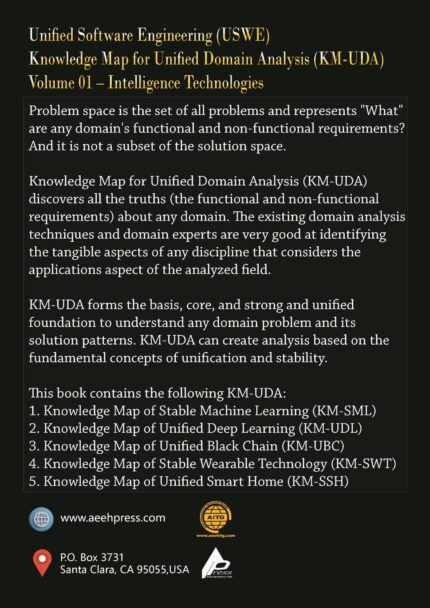
Problem space is the set of all problems and represents "What" are any domain's functional and non-functional requirements? And it is not a subset of the solution space. Knowledge Map for Unified Domain Analysis (KM-UDA) discovers all the truths (the functional and non-functional requirements) about any domain. The existing domain analysis techniques and domain experts are very good at identifying the tangible aspects of any discipline that considers the applications aspect of the analyzed field. KM-UDA forms the basis, core, and strong and unified foundation to understand any domain problem and its solution patterns. KM-UDA can create analysis based on the fundamental concepts of unification and stability. This book contains the following KM-UDA: 1. Knowledge Map of Stable Machine Learning (KM-SML) 2. Knowledge Map of Unified Deep Learning (KM-UDL) 3. Knowledge Map of Unified Black Chain (KM-UBC) 4. Knowledge Map of Stable Wearable Technology (KM-SWT) 5. Knowledge Map of Unified Smart Home (KM-SSH)
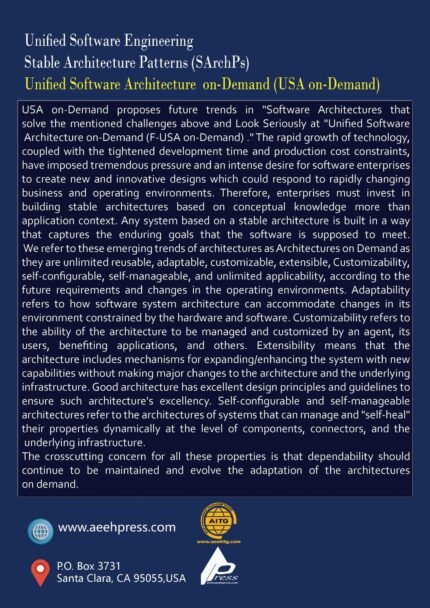
Stable Architecture Patterns (SArchPs) Unified Software Architecture on-Demand (USA on-Demand)
USA on-Demand proposes future trends in "Software Architectures that solve the mentioned challenges above and Look Seriously at "Unified Software Architecture on-Demand (F-USA on-Demand) ." The rapid growth of technology, coupled with the tightened development time and production cost constraints, have imposed tremendous pressure and an intense desire for software enterprises to create new and innovative designs which could respond to rapidly changing business and operating environments. Therefore, enterprises must invest in building stable architectures based on conceptual knowledge more than application context. Any system based on a stable architecture is built in a way that captures the enduring goals that the software is supposed to meet. We refer to these emerging trends of architectures as Architectures on Demand as they are unlimited reusable, adaptable, customizable, extensible, Customizability, self-configurable, self-manageable, and unlimited applicability, according to the future requirements and changes in the operating environments. Adaptability refers to how software system architecture can accommodate changes in its environment constrained by the hardware and software. Customizability refers to the ability of the architecture to be managed and customized by an agent, its users, benefiting applications, and others. Extensibility means that the architecture includes mechanisms for expanding/enhancing the system with new capabilities without making major changes to the architecture and the underlying infrastructure. Good architecture has excellent design principles and guidelines to ensure such architecture's excellency. Self-configurable and self-manageable architectures refer to the architectures of systems that can manage and "self-heal" their properties dynamically at the level of components, connectors, and the underlying infrastructure. The crosscutting concern for all these properties is that dependability should continue to be maintained and evolve the adaptation of the architectures on demand.

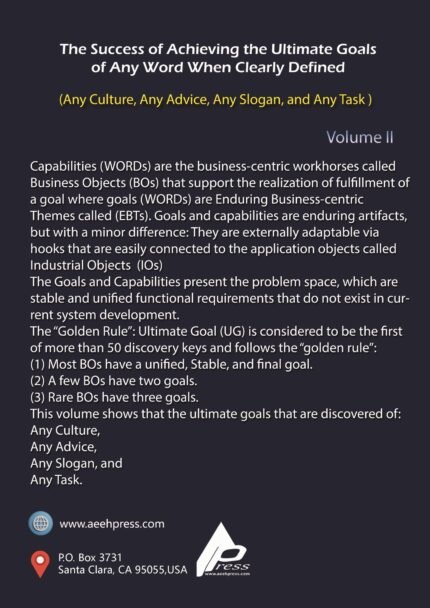
The Success of Achieving the Ultimate Goals of Any Word When Clearly Defined (Any Culture, Any Advice, Any Slogan, and Any Task )
Capabilities (WORDs) are the business-centric workhorses called Business Objects (BOs) that support the realization of fulfillment of a goal where goals (WORDs) are Enduring Business-centric Themes called (EBTs). Goals and capabilities are enduring artifacts, but with a minor difference: They are externally adaptable via hooks that are easily connected to the application objects called Industrial Objects (IOs) The Goals and Capabilities present the problem space, which are stable and unified functional requirements that do not exist in current system development. The “Golden Rule”: Ultimate Goal (UG) is considered to be the first of more than 50 discovery keys and follows the “golden rule”: (1) Most BOs have a unified, Stable, and final goal. (2) A few BOs have two goals. (3) Rare BOs have three goals. This volume shows that the ultimate goals that are discovered of: Any Culture, Any Advice, Any Slogan, and Any Task.

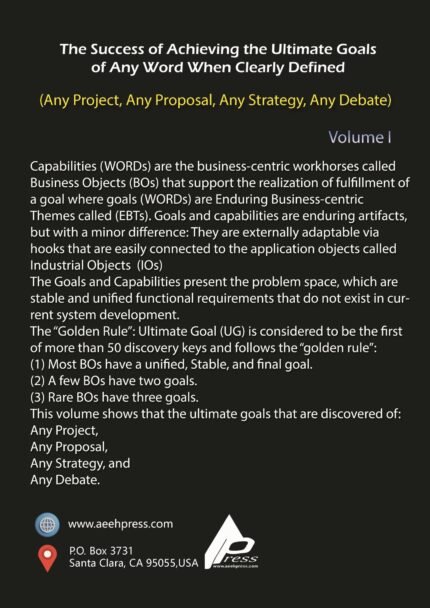
The Success of Achieving the Ultimate Goals of Any Word When Clearly Defined (Any Project, Any Proposal, Any Debate, Any Strategy)
Capabilities (WORDs) are the business-centric workhorses called Business Objects (BOs) that support the realization of fulfillment of a goal where goals (WORDs) are Enduring Business-centric Themes called (EBTs). Goals and capabilities are enduring artifacts, but with a minor difference: They are externally adaptable via hooks that are easily connected to the application objects called Industrial Objects (IOs) The Goals and Capabilities present the problem space, which are stable and unified functional requirements that do not exist in current system development. The “Golden Rule”: Ultimate Goal (UG) is considered to be the first of more than 50 discovery keys and follows the “golden rule”: (1) Most BOs have a unified, Stable, and final goal. (2) A few BOs have two goals. (3) Rare BOs have three goals. This volume shows that the ultimate goals that are discovered of: Any Project, Any Proposal, Any Strategy, and Any Debate.
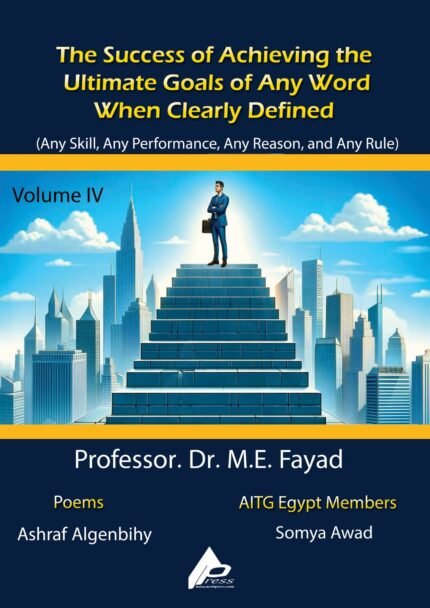
The Success of Achieving the Ultimate Goals of Any Word When Clearly Defined (Any Skill, Any Performance, Any Reason, and Any Rule)
Capabilities (WORDs) are the business-centric workhorses called Business Objects (BOs) that support the realization of fulfillment of a goal where goals (WORDs) are Enduring Business-centric Themes called (EBTs). Goals and capabilities are enduring artifacts, but with a minor difference: They are externally adaptable via hooks that are easily connected to the application objects called Industrial Objects (IOs) The Goals and Capabilities present the problem space, which are stable and unified functional requirements that do not exist in current system development. The “Golden Rule”: Ultimate Goal (UG) is considered to be the first of more than 50 discovery keys and follows the “golden rule”: (1) Most BOs have a unified, Stable, and final goal. (2) A few BOs have two goals. (3) Rare BOs have three goals. This volume shows that the ultimate goals that are discovered of: Any Skill, Any Performance, Any Reason, and Any Rule
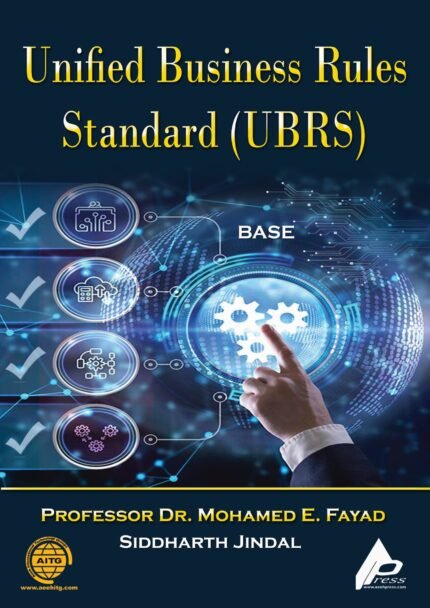
Unified Business Rules Standard (UBRS)
The current business environment's ever-changing market dynamics, like evolving user needs, faults, intrusions, etc., require constant updates to system behavior and resource availability. These changes, however, should be performed without significantly affecting the application structure, thus allowing the system to effortlessly optimize and tune itself at runtime to handle/manage any issues. Business rules are an effective tool to provide flexibility and control for rapidly deploying changes across business operations. However, most organizations still need help to explicitly define or model business rules, primarily because they lack a global and widely acceptable set of standards. Furthermore, current business rule standards are not flexible and adaptable for defining rules that can apply to any other application except the ones they are designed for. Such problem dependencies in traditional standards make them challenging to evolve and, hence, significantly limit their use. The Unified Business Rule Standard (UBRS) eliminates these dependencies by focusing on the core knowledge of the domain. It effectively means the changes can be carried out to the problem-specific components without affecting the core functionality. In other words, updating the business logic can occur without recompiling the application code.


Reviews
There are no reviews yet.